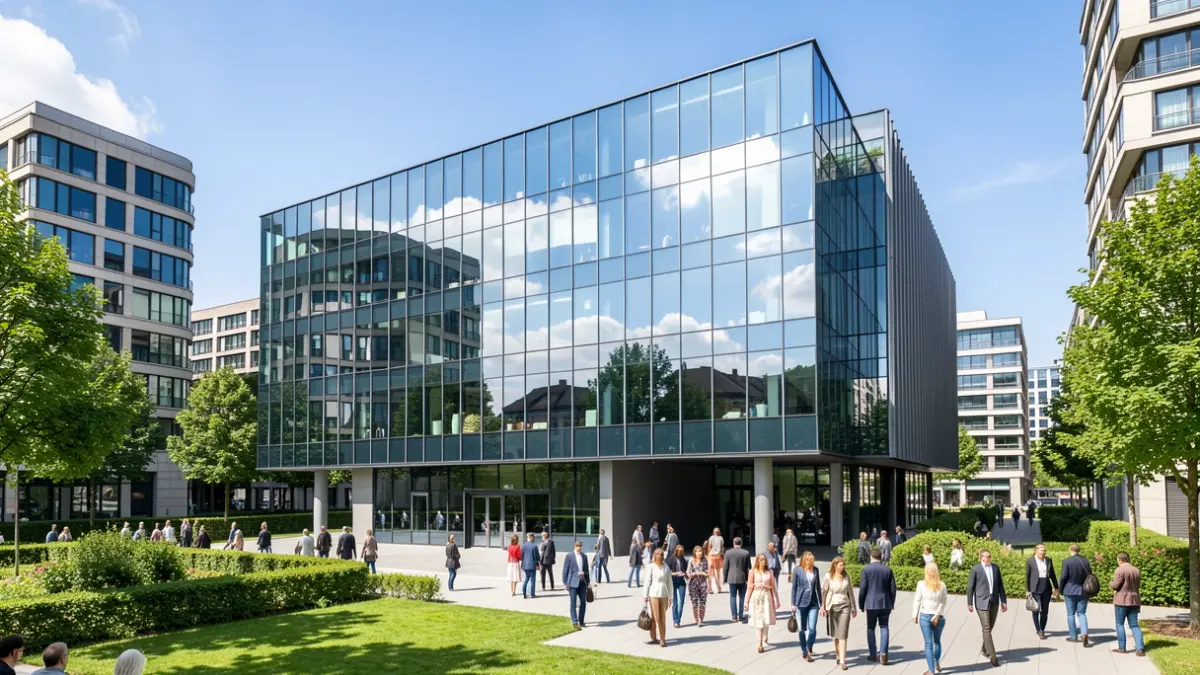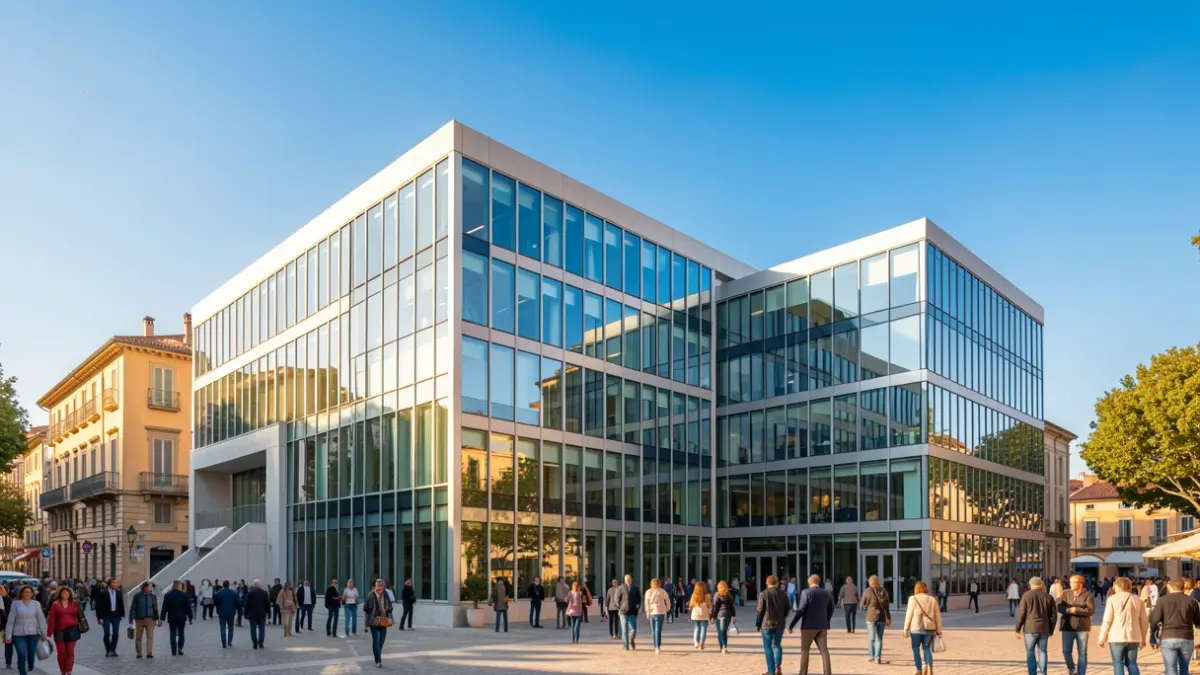
The University of Barcelona (UB) and the Catalan Land Institute (INCASÒL) have officially unveiled the two new strategic buildings to be constructed at the Diagonal Campus in the coming years. The event, held at the Faculty of Economics and Business, was attended by the President of the Generalitat of Catalonia, Salvador Illa; the Rector of the UB, Joan Guàrdia; and the Minister of Research and Universities, Núria Montserrat.
One of the new facilities will be a research building for health sciences south of Avinguda Diagonal, expanding the Barcelona Science Park (PCB-UB) by 10,000 m². This space will house the Institute for Bioengineering of Catalonia (IBEC) and the Fraunhofer CAT center, as well as UB's health sciences research activities.
The overall project, with a joint investment of 71.5 million euros from the Generalitat of Catalonia and the University of Barcelona, also includes a second building adjacent to the Faculty of Economics and Business. This will host the new headquarters of the Faculty of Mathematics and Computer Science and new research spaces in economics and business.
Construction is scheduled to begin in the fourth quarter of 2027 and will continue until 2029. This project follows up on the agreement signed between the UB and the Government in April 2024 to promote research and talent.
Rector Joan Guàrdia emphasized that the project is "creating the future of the University of Barcelona" and strengthens the institution as a "leader in research, capable of attracting top talent and serving the country".
For his part, President Salvador Illa advocated for "science and research against denialism" and stated that the initiative "is part of a long-term project that will transform the entrance to Diagonal".
The new PCB-UB building will have six floors and will be designed with 90 m² laboratory modules around a central atrium, allowing spaces to be adapted to various research needs.
The second building, spanning 14,000 m², will be structured in two volumes: a lower section for economics and business research, and a tower for the Faculty of Mathematics and Computer Science, connecting to the current CRAI Library of Economics and Business.
Designed to achieve near-zero energy consumption, this second facility will incorporate sustainable materials and energy efficiency solutions, including photovoltaic panels and renewable energy.