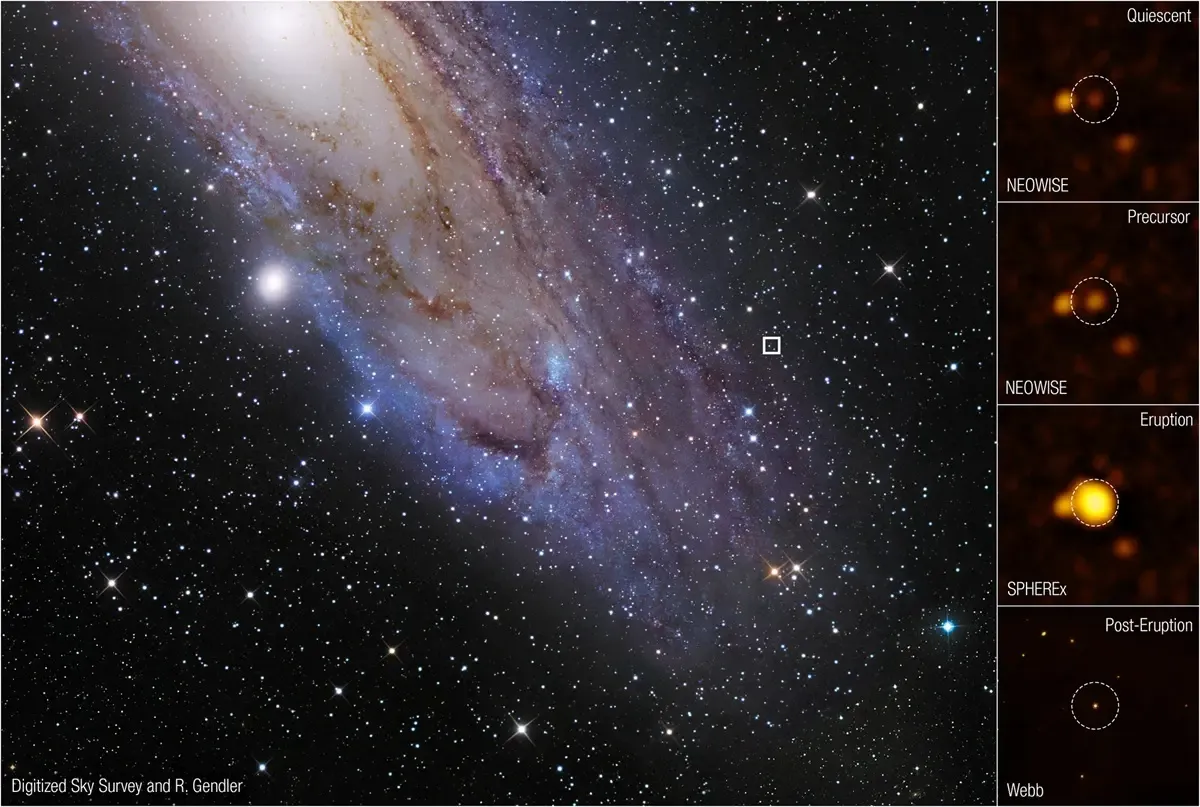
A research team has identified an unprecedented stellar phenomenon: a star slightly less massive than the Sun has merged with a supergiant star at the edge of the neighboring galaxy Andromeda. The team has nicknamed the new merged star «Bao». The discovery was reinforced by observations from the James Webb Space Telescope, operated by NASA, the European Space Agency (ESA), and the Canadian Space Agency (CSA), cross-referenced with data from space and ground-based telescopes. Researchers from the Institut d’Estudis Espacials de Catalunya (IEEC) at the Institut de Ciències del Cosmos of the University of Barcelona (ICCUB) participated in this work, published in the journal Nature.
«Stellar mergers are very difficult to observe in real-time because they are complicated to predict», explains Viraj Karambelkar, lead author of the paper and a NASA Hubble Fellow at Columbia University. «Webb observed Bao just 47 days after the stars' eruption reached its peak, the fastest follow-up ever of such an event». Before the transformation, the two stars orbited peacefully, but the merger occurred after only seven orbits, about seven years.
«We thought an outburst from such an extended star would take years», notes co-author Nadia Blagorodnova, an IEEC researcher at ICCUB. «One day, its brightness began to increase, and in less than a week, it reached its peak!» This process, known as common envelope evolution, involves one star stripping the outer layers of the other, causing gas to flow into the surrounding space.
The team reconstructed the events using simulations and Webb's mid-infrared observations. Before the eruption, the primary star, «Big Bao», had seven times the Sun's mass, 350 times its radius, and was 18,000 times brighter. The companion, «Little Bao», had less mass (about 0.7 solar masses) and lower brightness. Their encounter was «almost like a bomb exploding inside a living star», explains Kishalay De, a co-author and assistant professor at Columbia University.
The analysis of Bao (formally AT 2025abao) offers a new approach to reconstructing stellar events in real-time. This finding comes as NASA's Nancy Grace Roman Space Telescope is set to conduct extensive public surveys that could benefit from similar analyses. «There will soon be a huge avalanche of similar discoveries», anticipates Karambelkar.