What makes Rosa d'Abril different? An inside look at an educational community in Barcelona
By Jhonatan Guadalupe Santiago Ramírez
Specialist in educational management and social innovation. Master's in Social Entrepreneurship and Innovation from the Universitat Autònoma de Barcelona.
Barcelona boasts one of the broadest and most diverse educational offerings in Europe. Each year, hundreds of local and international families seek the place where their children will take their first steps in learning. The decision is not usually based solely on proximity or the center's prestige; increasingly, families are looking for schools where their children are accompanied with respect, where they can develop at their own pace, and where education is understood as a profoundly human experience.
Over the past few months, I had the opportunity to get to know one of these schools from the inside.
As part of my professional internships and later my organizational analysis work, I collaborated with the Centre d’educació Infantil Waldorf-Steiner Rosa d'Abril, a kindergarten located in Barcelona that, for over three decades, has been developing an educational project inspired by Waldorf pedagogy.
I arrived with the expectation of learning about a different methodology. I thought I would observe new teaching strategies or different ways of organizing the classroom. However, as the weeks went by, I understood that what truly distinguishes Rosa d'Abril cannot be summarized solely by a methodology.
Its greatest strength is the community it has managed to build.
At a time when education seems to be moving towards increasingly accelerated processes, this school offers something that is paradoxically innovative: pausing to listen to children, respecting their pace, and understanding that a child's development cannot be measured solely by the content they learn, but also by the quality of the experiences they have and the relationships they form.
This philosophy does not remain solely in institutional discourse.
It is perceived from the moment a family crosses the center's door.
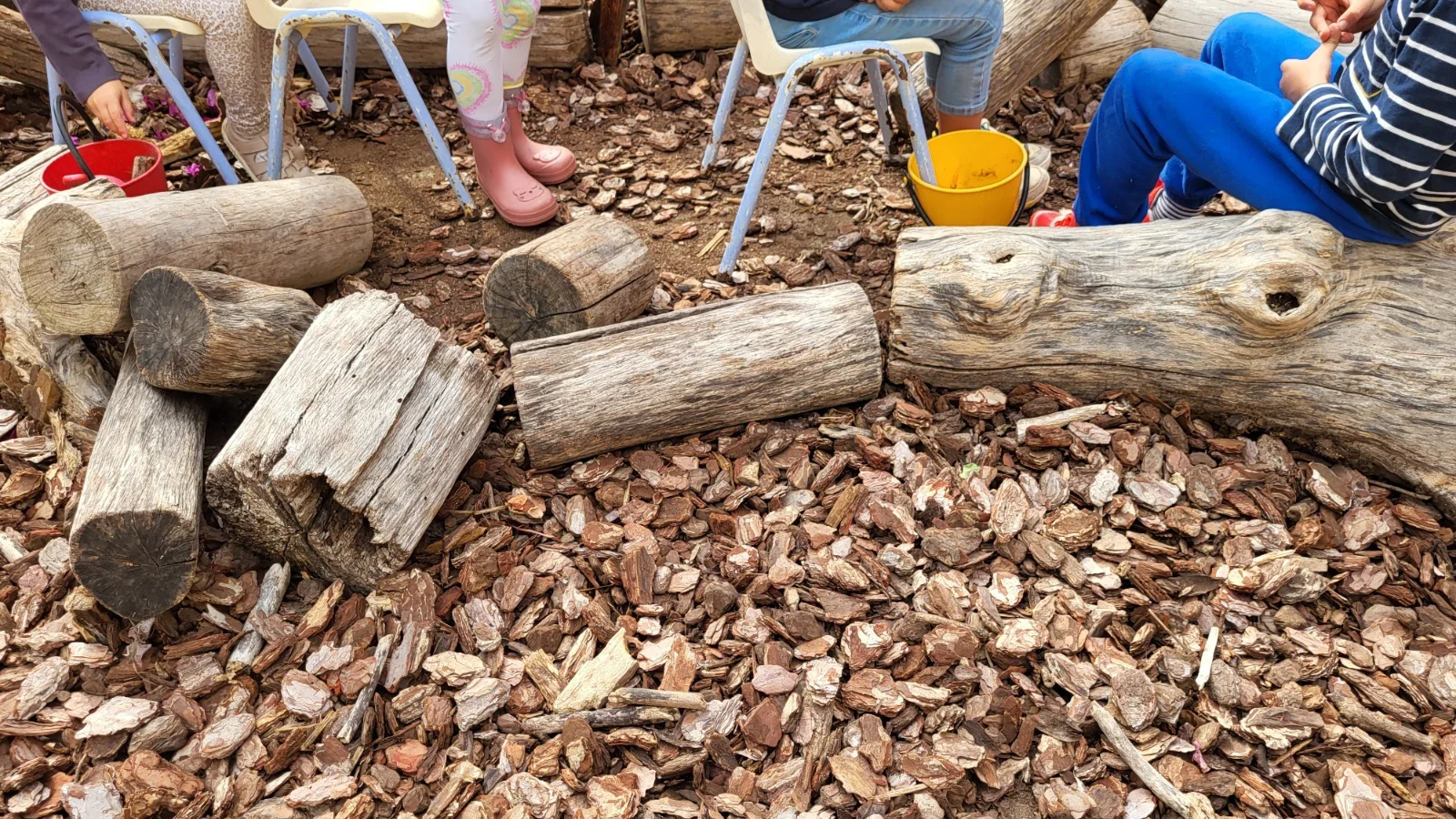
The closeness between educators, children, and families creates an atmosphere of trust that is difficult to describe solely through indicators or statistics. It is evident in the way each child is welcomed at the start of the day, in the daily dialogue with families, in the importance given to free play, creativity, contact with nature, and the creation of a serene environment where learning becomes a natural consequence of living.
As an education professional, one of the aspects that most caught my attention was the coherence between the educational project and daily practice.
In many institutions, strategic documents describe a reality that is later difficult to find in everyday life. At Rosa d'Abril, the opposite happened. The principles underpinning Waldorf pedagogy are reflected in every space, in the organization of the day, in the materials used, and, above all, in the way people relate to each other.
Another particularly relevant aspect is the diversity of its educational community.
During my stay, I lived alongside families from various countries such as Mexico, Argentina, Brazil, France, Canada, Germany, and different regions of Spain. This diversity makes the school a space for intercultural encounters where differences enrich the educational experience and strengthen the sense of community.
Precisely this reality led me to develop different proposals aimed at strengthening the school's institutional positioning among international families residing in Barcelona. Through organizational analysis, institutional communication, and the design of dissemination strategies, I understood that often the biggest challenge for educational projects with enormous human value is not improving what they do, but learning how to communicate it.
Today, schools do more than just educate.
They also need to explain who they are, what their values are, and why their project deserves to be known. This represents a particularly important challenge for independent centers like Rosa d'Abril, which compete in an environment with a wide educational offering and where families increasingly seek information before making a decision.
From my experience, I believe that one of Rosa d'Abril's greatest achievements has been staying true to its identity while continuing to adapt to new social challenges. Far from following passing trends, it has consolidated an educational project based on respect for childhood, active family participation, and the building of solid human connections.
Perhaps that's why, rather than talking about a school, those who are part of Rosa d'Abril usually talk about a community, and that difference is significant.
In an era where many institutions compete to offer more technology, more activities, or more services, discovering a space that places human relationships at the center of the educational process invites reflection on what it truly means to educate.
At the end of this experience, I understood that true innovation does not always come from incorporating new tools or methodologies. Sometimes it arises from something much simpler and, at the same time, much more difficult to build: a community that shares a purpose, accompanies the growth of children with respect, and understands education as a shared responsibility between the school and families.
After experiencing Rosa d'Abril from the inside, I can affirm that its greatest value lies not only in the pedagogy that inspires its project but also in how it has managed to turn that philosophy into a daily experience for those who are part of it.
Because, in the end, a good school is not remembered solely for what it teaches.
It is remembered, above all, for how it makes those who grow within it feel.