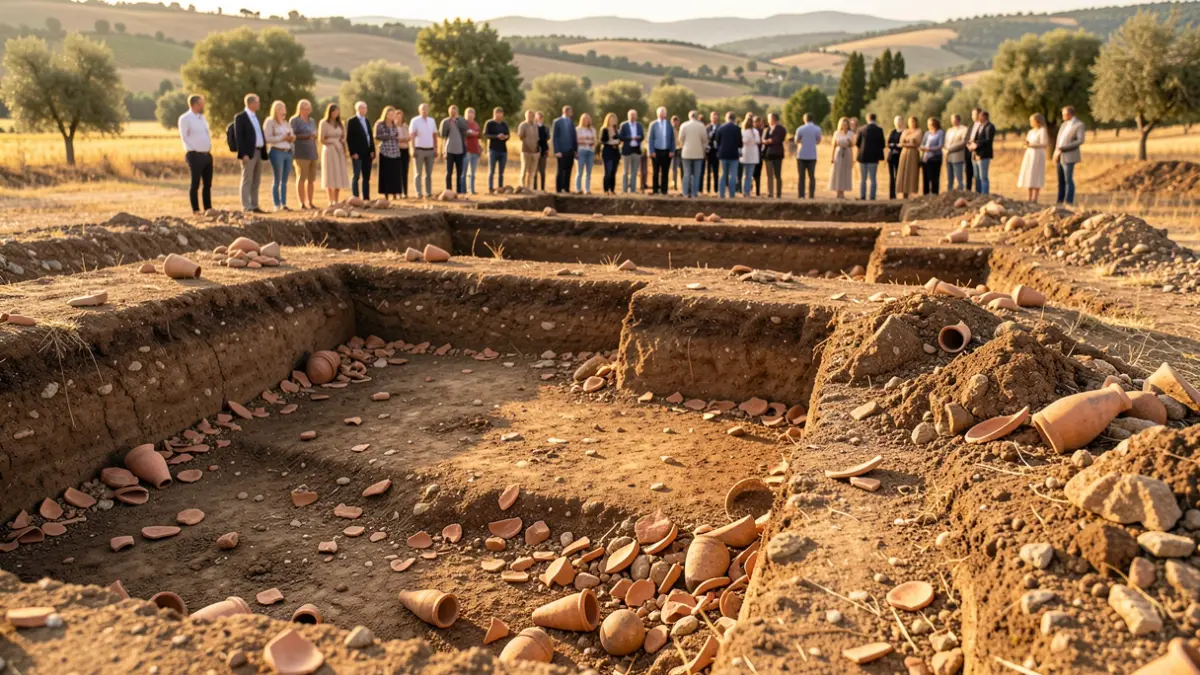
The Vallès region has been the scene of several archaeological finds in recent weeks, including sites at La Mola and Castellar Vell. This has sparked debate on whether we are in a particularly fruitful period for archaeology in the county. However, Jordi Roig, project director at Arrago SL, believes it's an accumulation of circumstances rather than a genuine boom. Roig notes that archaeological activity, closely tied to the construction sector, has seen a post-crisis decline, and current interventions often respond to urban development needs rather than research plans.
The case of Castellar Vell is notable for the discovery of 243 tombs in a necropolis, a funerary complex considered the most complete in Catalonia for the Carolingian and early medieval periods, and a European benchmark. This uniqueness, along with its optimal preservation state, offers a detailed view of the era's social hierarchy and the formation of Catalunya Vella and the County of Barcelona. In contrast, finds at La Mola are part of previous excavations at the monastery's cemetery, holding a different value.
The prevalence of medieval sites, such as those found around the Monastery of Sant Llorenç del Munt, is explained by the consolidation of settlements during the 9th, 10th, and 11th centuries, with the proliferation of churches, castles, and farmhouses. This era saw increased land occupation, including areas previously uninhabited. Arrago SL's excavations, driven by residential expansion, are not programmed research actions like university projects, although the current intervention at Castellar Vell does have an independent research component.
Jordi Roig is critical of the lack of synergy between the construction sector and academia, lamenting that many excavations have served construction needs without adequate subsequent study, leading to a scarcity of scientific reports. Santos M. Mateos, a Doctor of Art History, adds that while findings are always documented, the site's significance determines whether research is expanded or if it is protected and covered. Archaeological investigation often slows down construction processes, a dynamic evident in places like Tarragona.
Data from the Inventari del Patrimoni Arqueològic i Paleontològic de Catalunya (Inventory of Archaeological and Paleontological Heritage of Catalonia) suggest institutional commitment, although municipalities like Palau-solità, Polinyà, and Sentmenat have explored their subsoil minimally. In Santa Perpètua, 10th and 11th-century finds opened the possibility of a Roman origin for the site. In Sabadell, excavations at Sant Pau de Riu-sec uncovered over 300 tombs. Roig concludes that the current perspective is distorted by the link between excavations and construction, with many recovered remains not seeing the light due to a lack of dissemination by authorities.