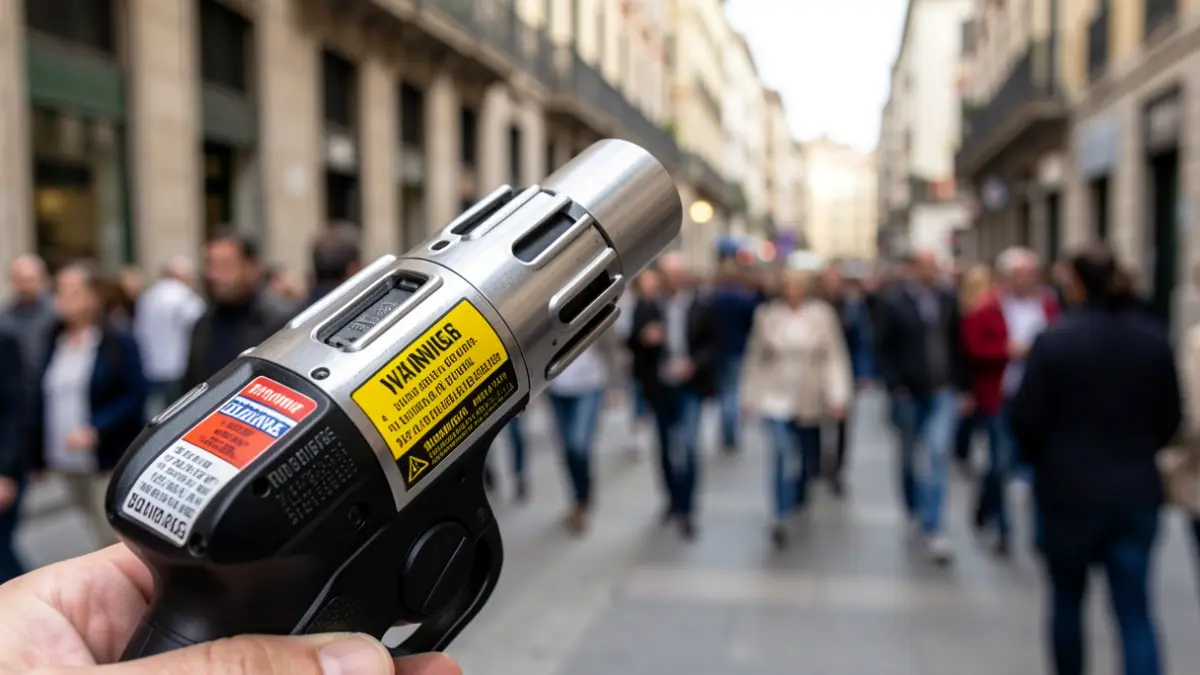
The regulation, which received the support of Govern, Junts per Barcelona, and the Popular Party, establishes the legal and operational framework for the use of this police tool. It sets the training requirements for officers and incorporates mechanisms for control, evaluation, and accountability. A public consultation period now opens before final approval by the City Council Plenary.
ECDs are incorporated as an intermediate tool between the extensible baton and firearms, aiming to provide an additional resource for dealing with situations of high complexity and serious risk to physical integrity. The regulation notes that this tool is part of the equipment of numerous police forces across the state, including the Mossos d'Esquadra, the National Police, and the Civil Guard.
The use of ECDs is restricted to situations where there is a serious risk to the life or physical integrity of officers, third parties, or the individual involved. They will be applied in actions such as violent assaults, threats with weapons, attempted self-harm, or other extreme necessity situations where imminent harm must be prevented.
Before using the device, and whenever circumstances permit, officers must exhaust avenues of dialogue, negotiation, and mediation, and clearly warn the affected person of the possibility of device use if their conduct does not change.
The text expressly prohibits the use of ECDs on immobilized or handcuffed individuals in police custody at police facilities, as well as in cases of purely passive resistance. As a general rule, they cannot be used on pregnant women, minors under 14, the elderly, or individuals particularly vulnerable due to health reasons, except in exceptional situations to prevent greater harm or immediate serious risk.
The regulation also stipulates that discharges must be limited to the minimum necessary to neutralize the existing threat and sets a maximum duration of five seconds per activation.
Only career officers of the Urban Guard who have completed the mandatory specific training and perform determined command or operational functions will be authorized to use ECDs. Training will include legal, operational, safety, and first aid content, as well as knowledge on the use of automated external defibrillators (AEDs), and specific training for interventions in mental health crisis situations, with participation from health institutions and specialized teams to enhance de-escalation and tension reduction techniques.
ECDs will incorporate technological systems to record activation time, number of discharges, and other relevant technical parameters. They will also include image capture systems, and officers carrying them must also have personal recording devices. After each use, health assistance must be activated, evidence preserved, and the circumstances of the intervention documented in the corresponding police report.
Annual supervision will be the responsibility of the unit within the Urban Guard tasked with the deontological and ethical evaluation of police actions, which will produce an annual report detailing the number of uses, incident types, presence of weapons, existence of potential mental health crises or substance use, profile of affected individuals, and any injuries sustained. This report will be made available to the municipal government, forwarded to the Ombudsman of Barcelona, and published according to municipal transparency criteria.
The regulation includes a specific evaluation during the first year of ECD operation to analyze implementation, protocol adequacy, and training provided, and to determine if improvements or future deployment adjustments are necessary.