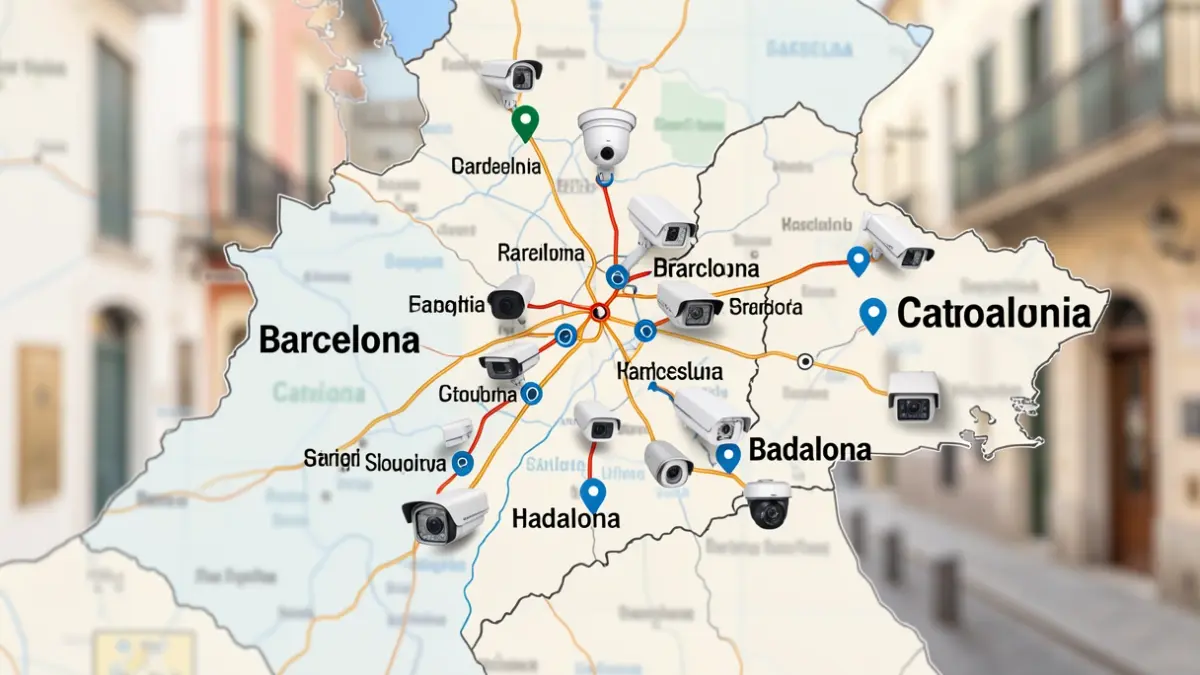
Catalonia currently has 5,556 police surveillance cameras in public spaces, distributed across 165 municipalities. These cameras, mostly located on streets, aim to deter crime and improve the public's sense of security.
Over 2,600 cameras are in towns with local police or municipal guards, who are responsible for managing these marked devices that continuously record high-traffic areas. Additionally, around 250 devices are in municipalities without their own security forces, but which use license plate reading cameras from the Lectio system for security tasks.
Barcelona leads in the number of street police cameras with 187 units, and 14 new ones have recently been installed in Plaça Catalunya and 13 along the waterfront. The City Council plans to install 500 more before the end of its term. Other notable municipalities include Lleida (nearly 90), Sant Cugat del Vallès, Castelló d'Empúries, and the area of Castell d'Aro, Platja d'Aro, and s'Agaró (around seventy each).
Badalona, although currently without cameras, plans to deploy 615 starting next year, with a contract tender of approximately 27 million euros.
In addition to street cameras, about 2,000 are designated for the protection of buildings and facilities, 604 belong to the Port Authority of Barcelona, 16 are located on roads, and 2 in the Cap de Creus Natural Park.
The installation of street cameras requires a request to the Control Commission for Videovigilance Devices, composed of members from the High Court of Justice of Catalonia (TSJC) and the Government. Images are stored with traceability and privacy protocols, and their validity is one year, renewable.
Images are stored for a maximum of three months, with tracking of their handling. Current systems do not include facial recognition or artificial intelligence for identification.
Sònia Andolz, a security analyst at the Catalan Institute for Peace (ICIP), warns of the risk of misuse and the impact on individual rights. She emphasizes the need to improve regulations and monitoring mechanisms to avoid a 'hyper-surveilled society'.
For municipalities without local police, the Mossos d'Esquadra created the Lectio system ten years ago, with 251 cameras in 67 participating municipalities, performing over 200 million license plate readings annually. This system aids police investigations and speeds up incident resolution.
The mayor of Castellvell del Camp, Josep Manel Sabaté, highlights the deterrent effect of Lectio cameras and their usefulness in solving cases.