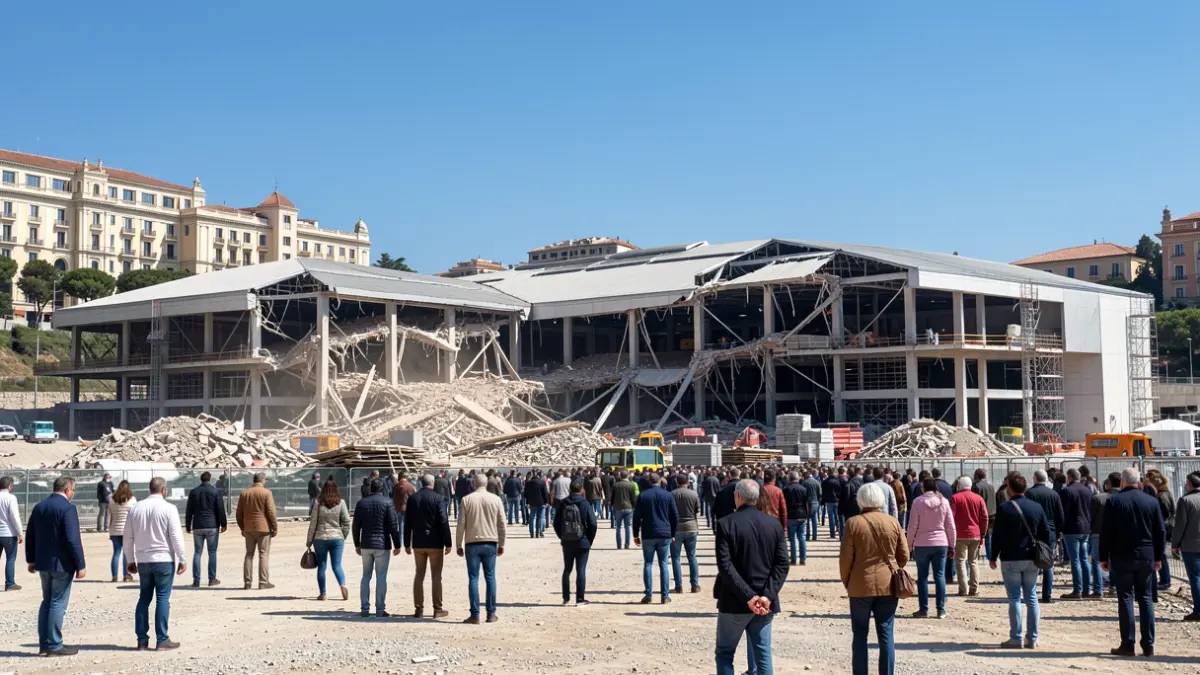
The first phase of renovation works at the Fira de Montjuïc exhibition center is progressing well. Following preliminary work that started earlier this year, demolition tasks have commenced on Palaces 4 and Congresses, where the future multifunctional hall will be constructed. Concurrently, asbestos roofing is being removed from the Alfons XIII Pavilion and the former Palau del Vestit. This aligns with the planned schedule to inaugurate the new spaces coinciding with the centenary of the 1929 International Exposition.
The Minister of Economy and Finance of the Generalitat, Alícia Romero, and the Mayor of Barcelona, Jaume Collboni, visited the construction site to assess the progress. The Managing Director of Fira 2000, Albert Civit, and the Chairman of Fira de Barcelona's Board of Directors, Pau Relat, also joined the delegation.
Mayor Collboni highlighted that the transformation of Fira de Barcelona aims to make it more urban, human-scale, and to connect the Poble Sec and Font de la Guatlla neighborhoods. He emphasized the goal of ensuring economic opportunities, as Fira is a key driver of economic dynamism, and affordable housing, with an additional 548 protected homes in the new Poble Sec, a new health center (CAP), and a new sports complex. He also underscored the creation of a new major civic boulevard along Avinguda Maria Cristina, which will add over 6,000 square meters of green spaces.
Minister Romero stressed the significant urban planning importance and substantial investment to support an urban fair deeply integrated with the city, which will allow for its modernization and the addition of new spaces. She also highlighted the city's and country's commitment to congress and convention tourism, projecting Barcelona internationally.
The installation of a 200-ton crane has marked the start of the demolition of Palace 4 and the current Congress Palace to build the future multifunctional hall. This new space, designed by architects Smiljan Radić, Miquel Mariné Núñez, Beatriz Borque, and Cesar Rueda Bonet, will span 20,500 m² over two floors, featuring a lightweight metal structure and a landscaped walkway on the Avinguda Maria Cristina facade.
In parallel, the current Alfons XIII Pavilion is being renovated, preserving the original structure designed by modernist architect Josep Puig i Cadafalch, to house the new Barcelona Congress Palace. The project, conceived by Forgas Arquitectes, Archambac, and Álvaro Alejandro Fernández, includes a new entrance, a 6,670 m² garden courtyard, and a large auditorium with a capacity for 2,025 people. Construction is scheduled to begin in September.
The Palau del Vestit will be transformed into a new innovation and economic activity center. The project, by Bjarke Ingels Group and MIAS Arquitectura, plans to preserve the colonnade and the front facade designed by Josep Maria Jujol. It will feature a functional three-story 'Z'-shaped building surrounded by public gardens and a 1,100 m² multipurpose community facility for the Font de la Guatlla and Hostafrancs neighborhoods.
The first phase of the renovation, coordinated by Fira 2000 SA, will involve an investment of 250 million euros for the new multifunctional pavilion and the rehabilitation of the Alfons XIII Pavilion, concluding in 2029. The renovation of the Palau del Vestit will cost 40 million euros.
The second phase of the project, planned between 2029 and 2035, will include the refurbishment of the Palace of Communications (Palace 1) and the Palace of Metallurgy (Palace 8). This planning will allow Fira de Montjuïc to maintain its operations during the construction period.