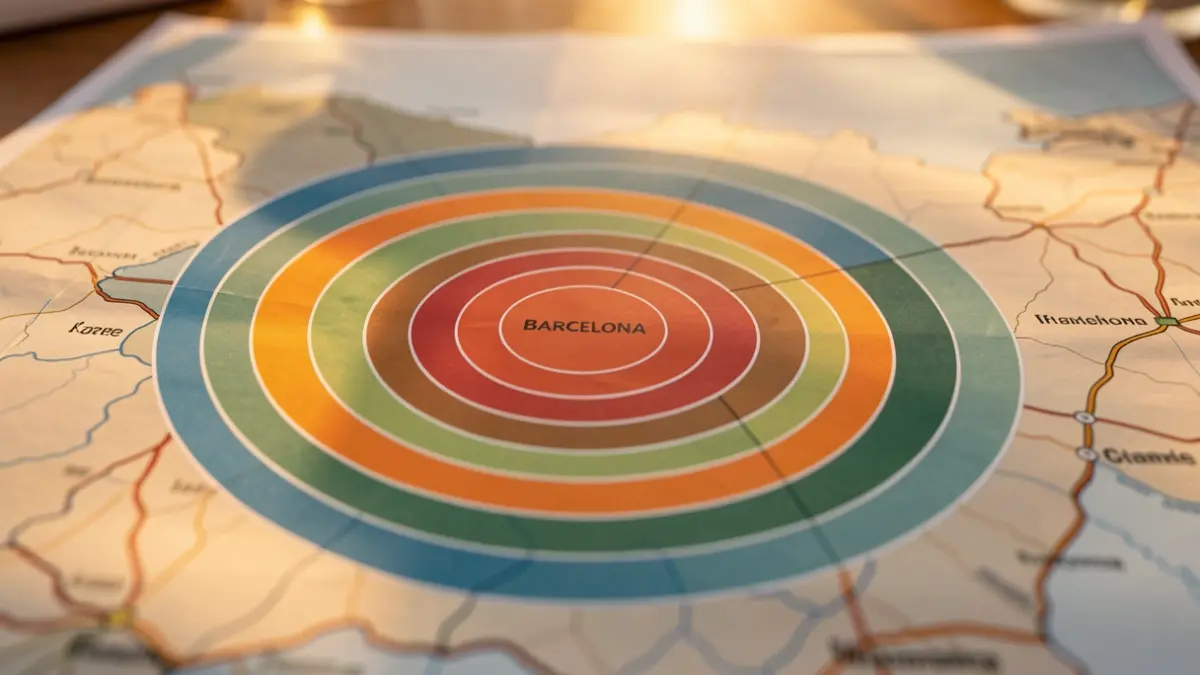
Complaints about Catalonia's public transport fare system continue to spark debate, especially in the municipalities of Vallès. It is criticized that short journeys may require payment for multiple zones, while much longer routes within the metropolitan area cost the same. Urban planner Manel Larrosa points out that the zone design disadvantages municipalities outside the immediate circle of Barcelona, citing the example that the journey from Sabadell to Barcelona is two zones, whereas from Terrassa to Barcelona it is three, despite the similar distance.
The concentric zone system of the Metropolitan Transport Authority (ATM), with Barcelona as its hub, has remained unchanged since its implementation in 2001. Marc Taulats, a member of the Association for the Promotion of Public Transport of Vallès Occidental, considers it a "very centralist" system and a "grievance" for current mobility needs.
Experts agree that the issue extends beyond price. Larrosa states it is an "unfair method" where Vallès faces higher fares for a "much inferior" service. He criticizes tax management, arguing that the property tax surcharge paid by metropolitan area municipalities does not justify the fare differences. While the 18 municipalities in the first zone (TMB) receive direct subsidies from the Generalitat, the 36 localities in the AMB (first and second zones) contribute via property tax, but only those within TMB receive government aid.
Years ago, an evolution towards a payment system based on distance and travel time, utilizing new technologies, was announced. According to Taulats, it was promised that the T-Mobilitat would allow travel throughout Catalonia with a single pass, but the project has not materialized. Larrosa laments the lack of transparency regarding the destination of ATM's resources.
Both experts consider a mileage-based fare system "entirely possible," but emphasize the need for "political will." They propose a method that records user entries and exits to create a fairer system that penalizes municipalities far from Barcelona less. Currently, geographically adjacent cities may require two-zone tickets if different types of public transport are used.
Taulats suggests that while the ideal solution is technologically feasible, it might be outdated compared to newer European models. A less ideal alternative would be to expand the current zones to make them fairer for residents of Vallès, although he acknowledges that "Barcelona rules despotically."