The Dofins Urbans project, driven by the University of Barcelona (UB) and the Zoo de Barcelona Foundation, with support from the Sustainable Blue Economy Chair UB-Tecnoambiente, the Port of Barcelona, and Amarres de Barcelona S.L., aims to highlight and deepen the understanding of the marine fauna diversity inhabiting the metropolitan coastline of Barcelona. This initiative also offers a training opportunity for UB students in the study of these species.
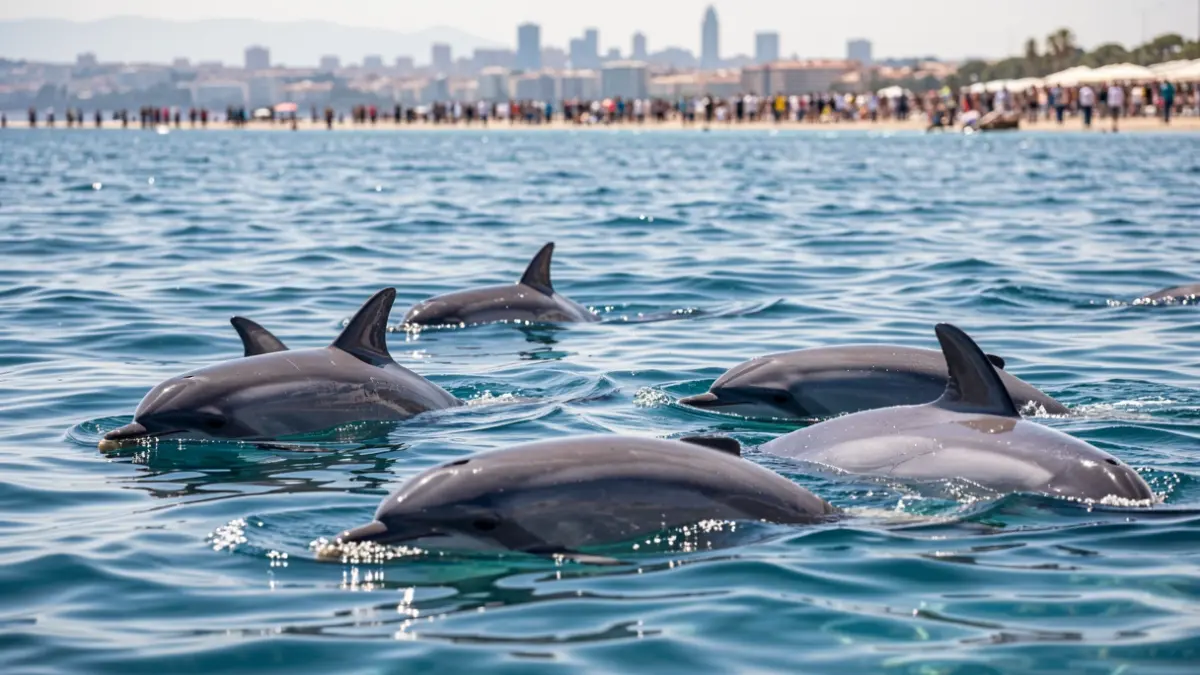
Since its launch nine months ago, the program has recorded 132 sightings of different species. According to Manel Gazo, professor and researcher in Marine Biology at the UB and project leader, common dolphins are particularly present, including adults, calves, and juveniles, coexisting in urban and port environments.
The project focuses on improving knowledge of the common dolphin (Tursiops truncatus) population in the Western Mediterranean, with a special emphasis on their presence, distribution, behavior, and threats within 10 nautical miles of Barcelona's coastline, between the Besós and Llobregat rivers. The initiative began with the purchase of a hydrophone to capture underwater sounds of cetaceans, followed by a collaboration with Amarres de Barcelona, S.L. for monthly sampling trips.
Since November 2025, ten monitoring trips have been completed, averaging 4.5 hours of daily navigation and covering approximately 500 nautical miles in total. This data constitutes one of the first systematic series of cetacean monitoring in this sector of Barcelona's coast, as highlighted by Gazo.
The initiative is based on three main actions: acoustic monitoring with a hydrophone to detect the presence and activity patterns of common dolphins and other odontocetes; visual monitoring with monthly sighting trips for the creation of a marine megafauna photo-identification catalog and analysis of abundance and distribution data; and the establishment of an information and sighting communication network in collaboration with marine sector entities.
Scientists and students will conduct regular trips over a year to diagnose the marine fauna of the Barcelona conurbation and the port's influence zone. "For cetaceans, we combine visual observation with acoustic monitoring to understand how these 'urban dolphins' that visit our waters use the space," explains Gazo.
In a recent outing, a large group of common dolphins was observed in the midst of the urban and port environment, a finding that underscores the daily coexistence of these animals with human activity in one of the most intensely used maritime areas of the Mediterranean.
Researchers emphasize the special value of being able to conduct this science "right at home," in the city's own waters, to better understand the emblematic species that still coexist with Barcelona. The idea is highlighted that "Blue Economy Barcelona must also allow us to win back the sea."
There is a large population of common and striped dolphins (Stenella coeruleoalba) along the Catalan coast. A Marine Sciences student is developing a fin catalog for photo-identification, aiming to compare it with existing records from the Costa Brava and the southern Catalan coast.
Starting in September, the interaction with fishing activities will be analyzed to determine if dolphins feed on the catches from trawlers and small-scale fishing gear, as observed in other areas of the Catalan coast. Currently, there are no complaints from Barcelona fishermen related to these interactions.