The teachers' protests of recent months, marked by a notable "yellow tide," have dwindled into small groups following the pre-agreement reached between unions and the Government. However, striking images have still been seen, such as an encampment in the center of Girona or an unusual meeting in the atrium of the Montserrat basilica. These groups question an agreement that, while improving salaries, they believe does not solve the crisis in the classrooms.
A quarter of teachers have participated in the consultation launched by USTEC, CGT, and Intersindical, the results of which will be announced soon. The teachers' decision could lead to the de-escalation of strikes or an increase in conflict, with an eye on the Pope's visit to Barcelona next week and a potential indefinite strike.
In a joint statement, the teachers' assemblies have requested "time" to analyze the agreement, although they consider the document agreed upon with the majority unions (USTEC, Professors de Secundària, CCOO, and UGT), representing 80% of the public school union force, to be "insufficient." CGT, which has not signed the pact, has argued that it will not have a "significant impact in the classrooms."
In Montserrat, critical teachers entered the atrium to discuss the agreement, bypassing security. They insist that the agreement does not significantly reduce class sizes (20 students in primary next year and 25 in secondary within two years) and lament the absence of a clause linking salaries to CPI increases, an issue that the department and unions attribute to negotiations in Madrid.
In Girona, half a thousand people demonstrated and camped, opting for a "no" in the consultation, despite the majority unions having called off the strike. In Manresa, about 200 teachers also took to the streets, expressing distrust towards a document they consider "not concrete."
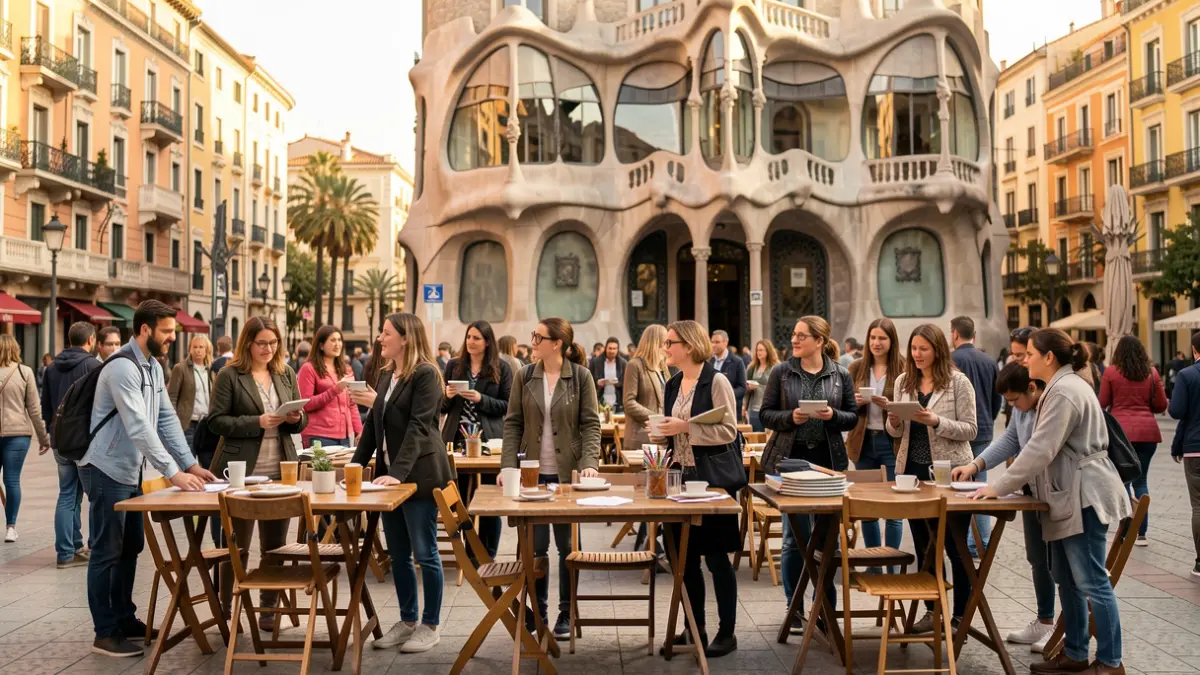
Protests continued in Barcelona, with demonstrators led by minority unions blocking access to the Casa Batlló. Gaudí's iconic building could not open, and Passeig de Gràcia was cut off, a scene similar to the previous week in front of the Sagrada Família. The main arguments for the critical "no" are the lack of specificity, class sizes, and general distrust.
According to official departmental data, 11% of teachers have supported these strike days, a notable figure despite the reduction compared to the previous week, as four out of the five unions present in the sectoral table had called off the protests until Friday. Last week, the Government estimated the stoppages between 20% and 35%.
The new pact foresees a salary increase that almost doubles that of March, with nearly 400 euros per month from the regional part and around 600 euros if the state part is included. It also incorporates the repayment of the "stadium" debt to about 35,000 teachers. Despite this increase, critics believe it does not reverse the accumulated loss of purchasing power since the austerity measures.
Approximately 94,500 public school teachers are called to participate in the consultation. The Minister of Education, Esther Niubó, has warned that a "no" could usher in an era of "chaos" and "absolute weakening" of the educational system. However, she has opened the door to further discussions on improvements, a stance shared by the unions, who are campaigning for a favorable vote to "consolidate" the achieved improvements.