The frenzy for World Cup football stickers has generated unprecedented demand, turning their acquisition into a real odyssey for many fans. Even the distributing company, Panini, has experienced significant stock shortages.
At Panini's factory in Modena, Italy, work is underway around the clock to try and meet a demand that clearly outstrips supply. Despite production efforts, stickers are arriving at points of sale in very limited quantities.
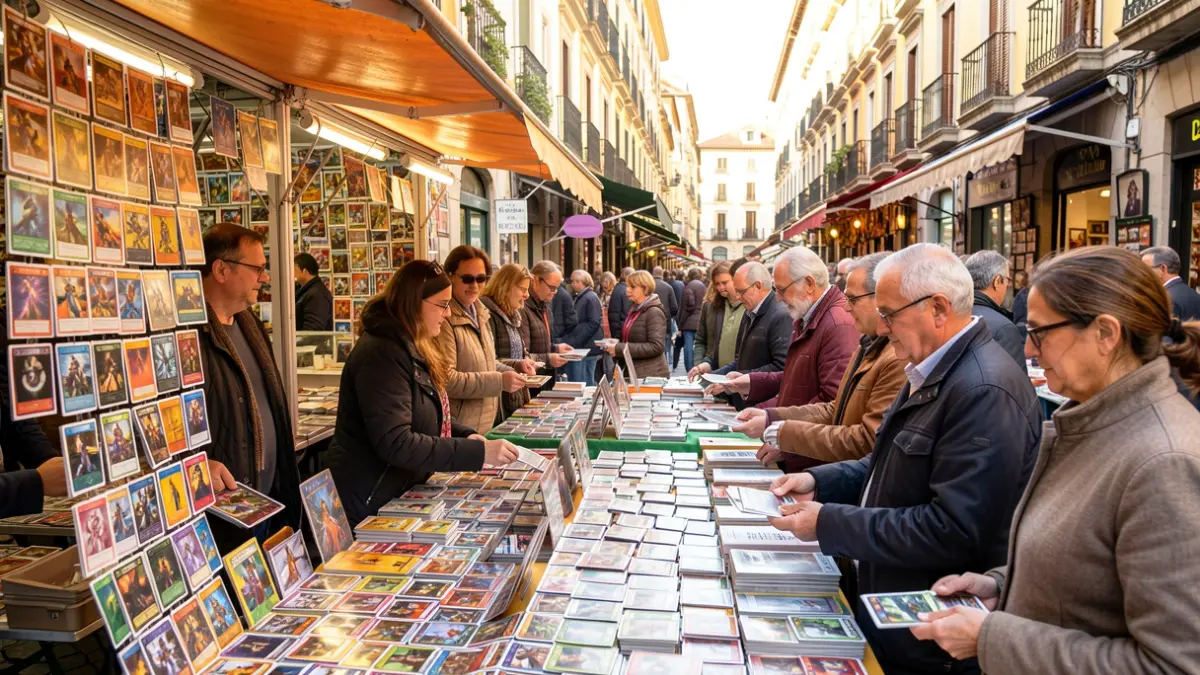
This situation has resulted in long queues of buyers visiting various establishments, empty shelves in stores, and notable crowds, such as those observed at Sant Antoni Market in Barcelona, where collectors gather to trade the stickers they need to complete their albums.
The surge in collecting is not limited to Catalonia but extends to countries like Portugal, Germany, and Chile, even though the latter is not participating in the tournament.
The tradition of stickers, over a century old, has re-emerged strongly thanks to Panini, the same company that popularized mass collecting in the 1960s with FIFA stickers. The current collection requires nearly a thousand stickers to complete, a higher number than previous World Cup editions, but this alone does not explain the current fever.
According to the general director of Panini Spain, Lluís Torrent, the length of the World Cup, which this year features 980 stickers, is one of the reasons, but there is no single, clear explanation for this phenomenon.
Panini assures that stock problems will be resolved this week. Torrent dismisses the idea of mass hoarding for resale, stating that production has never ceased and demand has simply exceeded supply capacity. He advises consumers not to buy at inflated prices and to visit official points of sale.
However, the reality at kiosks is one of low availability and rapid sales. One vendor recounts how a box of stickers sold out in a minute, describing the situation as a monopoly. Another customer found their first sticker behind the label of a soft drink bottle.
Kiosk owners confirm that stickers arrive sporadically and sell out quickly, with items lasting less than half a morning. Demand is constant, with customers continuously inquiring about their availability.
The most coveted stickers are those of players like Lamine Yamal, Leo Messi, and Cristiano Ronaldo. At Sant Antoni Market, children and adults gather to trade duplicate stickers, facilitating the task of completing the album. Messi's sticker, in particular, is described as an "impossible mission" to find, even among trades.
The popular song "tengui, falti" (have it, missing it) continues to be the soundtrack to these exchanges, reflecting the persistence of the collecting tradition.
Individual sticker prices vary by player. Basic ones sell for 25 to 30 cents, while the most sought-after, like those of Messi or Lamine Yamal, can fetch up to 10 euros. Vendors warn of unfair competition from a black market around the market, where special stickers have been offered for high amounts, such as Lamine Yamal's gold sticker for 100 euros.