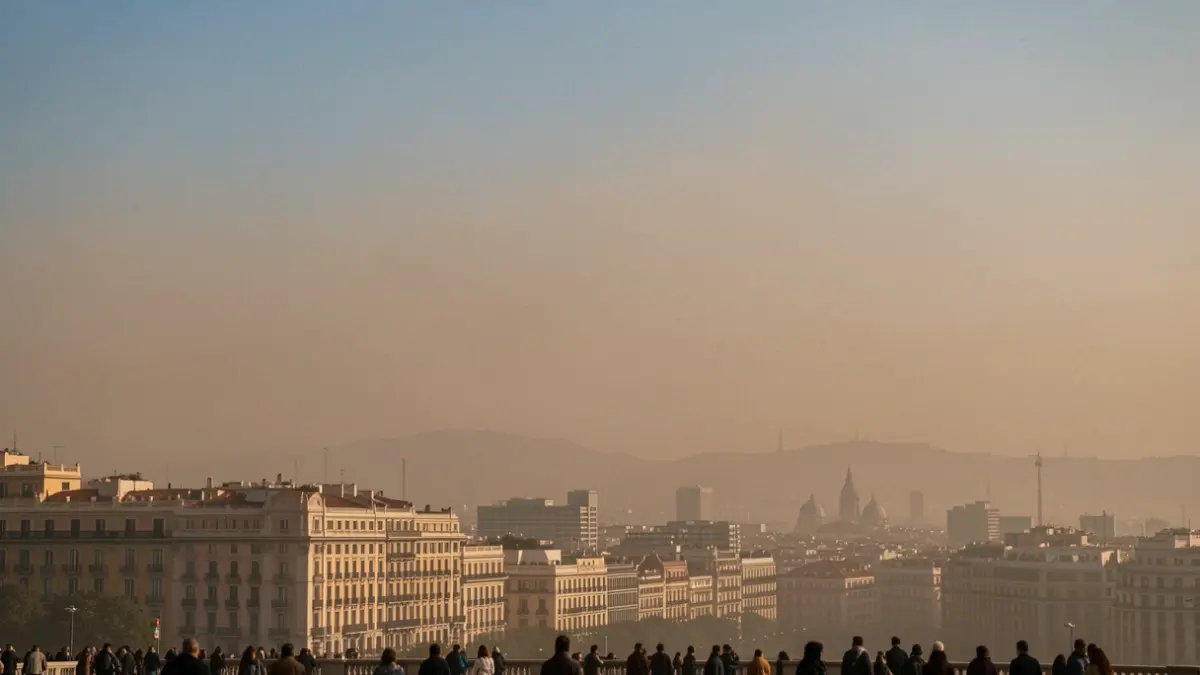
A notable Saharan intrusion has left the sky over Barcelona and all of Catalonia tinged with whitish and brownish tones, replacing the usual blue sky. This phenomenon, known as dust in suspension, is not new to the region or to Europe, but it appears to have become more frequent and persistent in recent years.
North Africa, particularly the Sahara Desert and the Bodélé Depression in Chad, is the planet's main source of mineral dust. Strong winds from this area, such as the harmattan, lift nutrient-rich particles that can travel thousands of kilometers, even reaching the Amazon rainforest to fertilize it.
The arrival of this dust in Barcelona occurs when southerly winds at altitude, often associated with low-pressure systems west or southwest of the Iberian Peninsula, transport the dusty air mass towards Europe. Strong convection in desert areas and the saltation mechanism, where larger sand particles impact and release fine particles, are key to its suspension.
The increase in the surface area of the Sahara Desert, estimated at 10% over the last century, could be one of the reasons for the increased frequency of these intrusions. Changes in atmospheric circulation that favor persistent southerly winds could also contribute, although there is uncertainty regarding this latter hypothesis.
While Saharan dust provides beneficial nutrients for forests, such as iron and phosphorus, it can also have negative health effects. It can transport viruses and bacteria, affecting the lungs. Therefore, during Saharan intrusion episodes, outdoor sports are discouraged to avoid inhaling these fine particles.