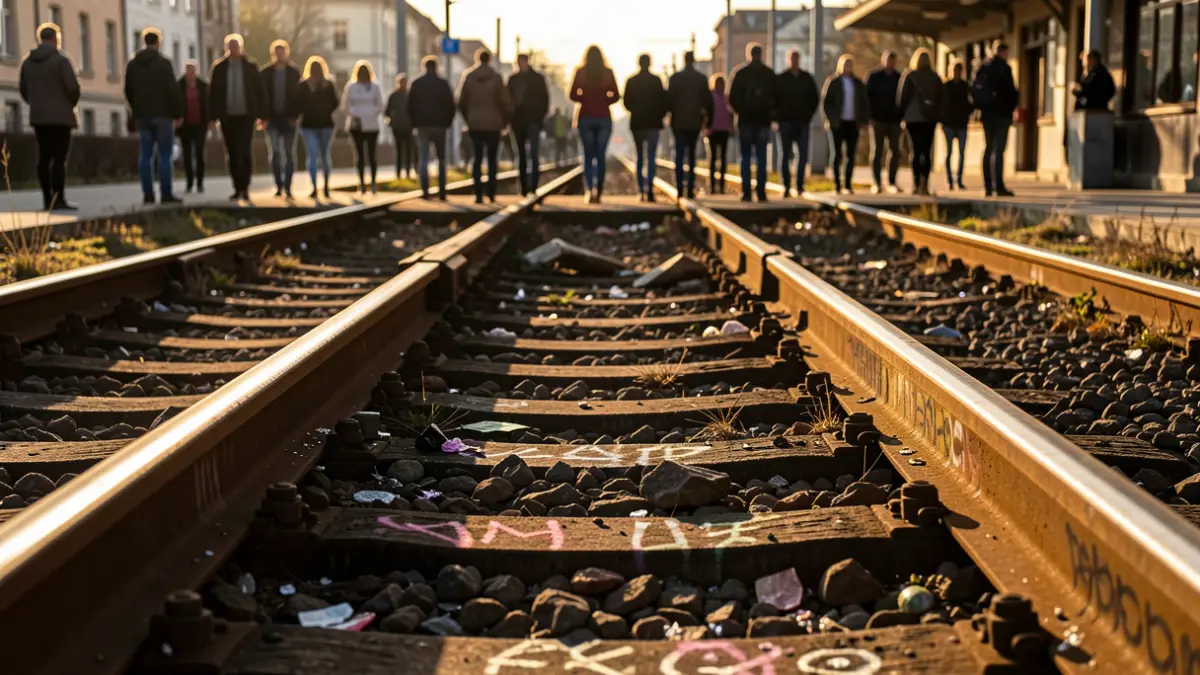
The CEO of Rodalies de Catalunya, Òscar Playà, has summarized the numerous external incidents affecting the Catalan railway network. Among the main problems are cable theft, which has doubled compared to the previous year, and graffiti. Playà noted that the number of stopped trains has been reduced thanks to increased cleaning efforts. Furthermore, Catalonia is the autonomous community with the most collisions, 99% of which are considered suicides. Work is underway with the Department of Health and Adif to close the tracks most affected by these accidents.
Playà has warned of the "vandalism" affecting the infrastructure and trains, not to mention breakdowns, IT system collapses, broken overhead lines, slope collapses, or trees on the tracks, all factors contributing to the high number of delays on the Catalan railway service.
These statements were made during the Railway Policy Conference held by the Department of Territory at the College of Civil Engineers of Barcelona. The conference was inaugurated by the Secretary of Mobility and Infrastructure, Manel Nadal, who reaffirmed the Generalitat's intention to exercise all railway competencies. Nadal celebrated the recovery of all lines, though not all services, following the crisis of January 20th in Gelida.
The Commissioner for the Integral Transfer of Rodalies, Pere Macias, has emphasized the need for "suitable rolling stock", indicating that the current fleet is becoming obsolete. He recalled that from 2030 onwards, 129 trains of the 447 series, over 30 years old, will enter service, necessitating their replacement.
Regarding the transfer of the R1 line (Molins de Rei - Maçanet-Massanes), Macias assured that it will be effective "in the coming months". The Generalitat will assume the infrastructure and, if necessary, will contract services from ADIF. The annual fixed costs for the R1 are 17.08 million euros, with a necessary annual investment of 33.39 million, resulting in an investment deficit of 460 million euros.
Macias announced that, after the R1, the next lines to be transferred will be the R3 (L'Hospitalet - Puigcerdà/La Tor de Querol), currently experiencing poor service and affected by works, and subsequently the R2 South (Sant Vicenç de Calders - Estació de França), followed by the R4 North and the Tortosa and airport sections.
Òscar Playà acknowledged being the sole employee of Rodalies de Catalunya six months after its establishment, with the objective of improving the service and making the transfer effective, planned for 2028, once the railway license is obtained.
Playà indicated that after the January crisis, "green shoots" are beginning to be detected, with the railway license processing being "well advanced" and the company's strategy and business plan being developed.
For his part, the deputy director of Adif Catalunya, Àngel Contreras, recalled that after the Gelida accident, over 1,000 km of track were inspected in two months with more than 400 personnel. Temporary speed restrictions have been reduced from 216 to 135, and work is underway to duplicate the Garraf tunnel.