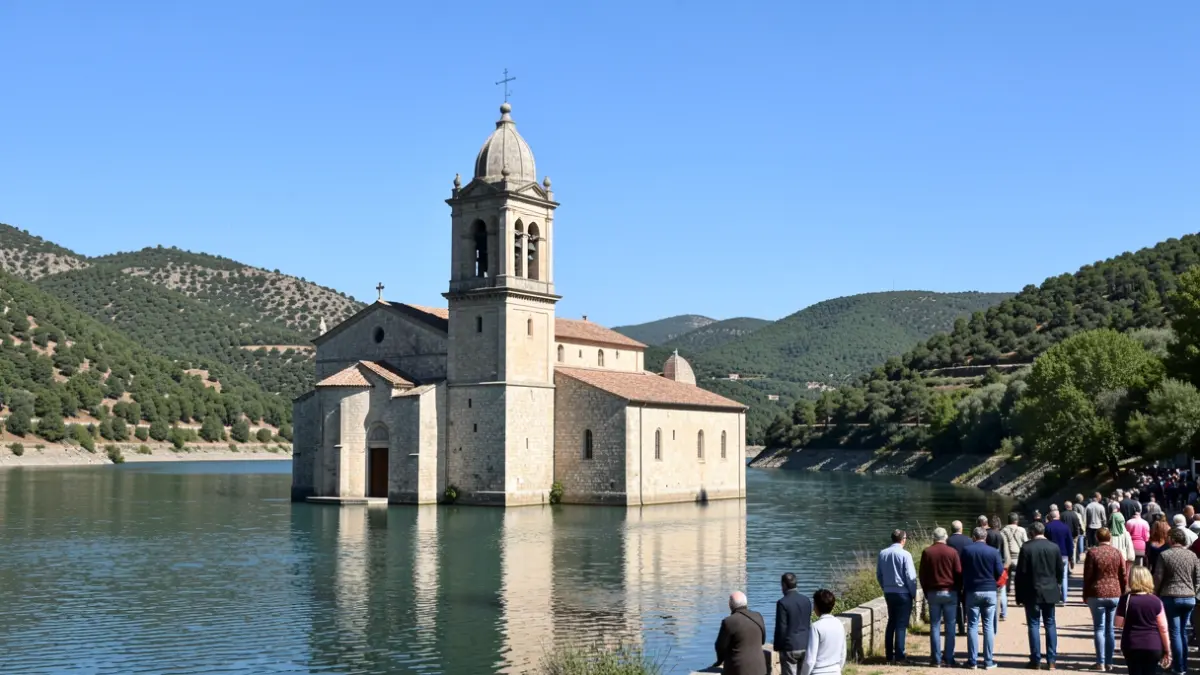
A study conducted by the entity Official World Record, in collaboration with the Grup de Recerca de Didàctica del Patrimoni of the University of Barcelona, has validated that the Catalan sanctuary is a unique case worldwide. The construction, consecrated in the year 1062, is partially submerged in the Sau reservoir, in Vilanova de Sau (Osona).
The history of Sant Romà de Sau is linked to the construction of the dam on the Ter river between 1942 and 1969. The subsequent filling of the reservoir in 1962 caused the village to be completely covered by water, forcing its inhabitants to relocate to a new residential area.
Its characteristic Lombard-style bell tower is not only a tourist attraction but also serves as a visual indicator of the water level. According to data from the Catalan Water Agency (ACA), the Sau reservoir currently exceeds 90% of its total capacity, although recently, in March, it was on the verge of overflowing.
The investigation by Official World Record began in 2020 with the aim of documenting Romanesque hermitages and churches underwater. During this process, they discovered the uniqueness of Sant Romà de Sau, which is located at a depth of 23 meters. This finding was subsequently included in the 'Guinness World Records' book from 2021.
The same book also features other records, such as the Sagrada Família Basilica, recognized as the world's tallest church at 172.5 meters and the oldest active construction project, initiated in 1882.