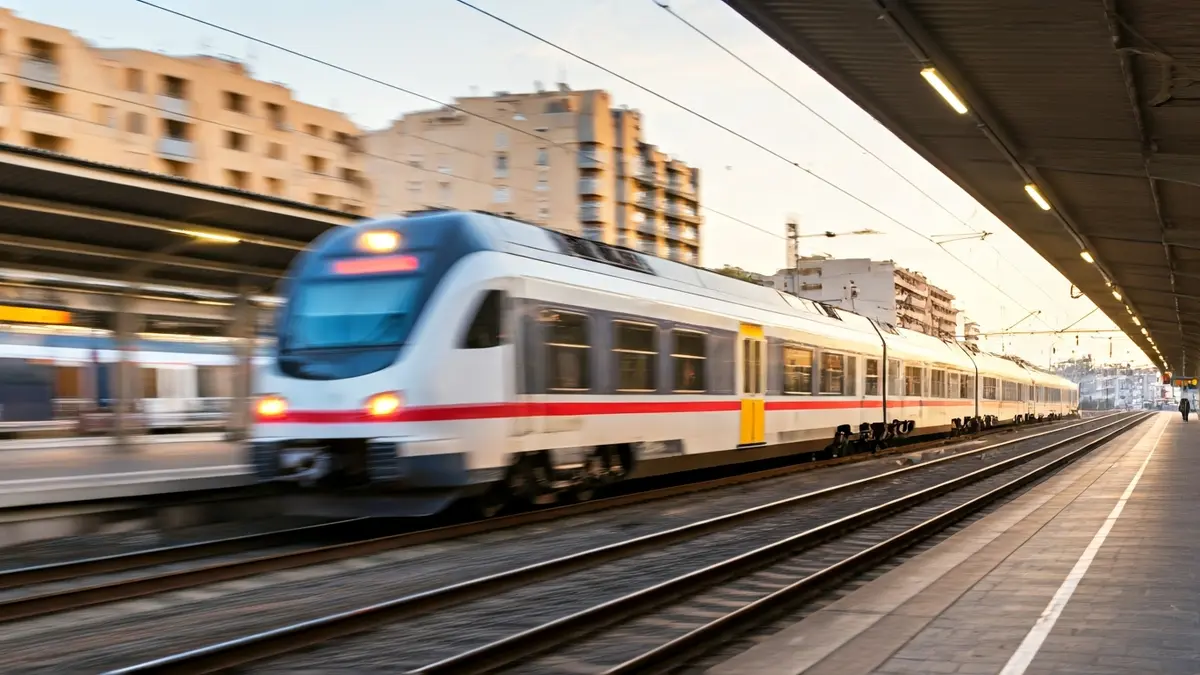
The study, based on official timetables from May 2000 and November 2025 (before the Gelida accident), indicates that trains needed up to half an hour less to complete some routes. This difference is partly explained by the fact that 25 years ago, many trains made fewer stops.
The analysis considered the shortest journey times towards the Catalan capital, prioritizing services with fewer stops and those that recorded the fastest times both a quarter-century ago and recently, excluding the first and last trains of the day as they are not representative.
“"There is an increase in trains that stop at all stations and in frequencies, but what has not increased is the capacity of the network."
Ramírez argues that the increase in trains and stops forces faster services to yield space, extending travel times or even leading to the disappearance of semi-direct trains. Therefore, he advocates for expanding the network's capacity to offer both all-stop and semi-direct services.
For his part, Joan Carles Salmerón, director of the Centre d'Estudis del Transport, attributes this situation to a lack of investment in infrastructure, which has weakened the railway system. He points out that, although investments began about three or four years ago, ongoing works have also contributed to longer travel times.
Salmerón also calls for the return of semi-direct trains, which would imply the construction of new passing tracks. He welcomes the fact that the Generalitat is developing a service plan, a tool he considers crucial and that has been absent for decades, as until now only infrastructure plans based on physical construction had been prioritized.
The lines connecting Camp de Tarragona and Terres de l'Ebre with Barcelona are particularly affected. A journey from l'Aldea-Amposta or Tortosa to Sants, which in May 2000 took 1 hour and 59 minutes and 2 hours and 10 minutes respectively, in November 2025 extends to 2 hours and 14 minutes and 2 hours and 26 minutes. Time increases are also observed in connections with Valls and Tarragona.
The solutions proposed by Adrià Ramírez include infrastructure maintenance to prevent incidents and the expansion of network capacity, such as quadrupling tracks between Castelldefels and El Prat, or tripling them between Montcada i Reixac and Mollet del Vallès. He also mentions the need for more tracks for parking trains and repair workshops, and criticizes the 11 delayed studies by the Ministry of Transport.
Finally, Joan Carles Salmerón warns that Catalonia's demographic growth, which could reach 10 million residents, will require new lines and stations to accommodate the increase in train users. He recalls that the last infrastructure plan that was fully implemented dates back to the 1960s and 1970s, when the population was significantly smaller.