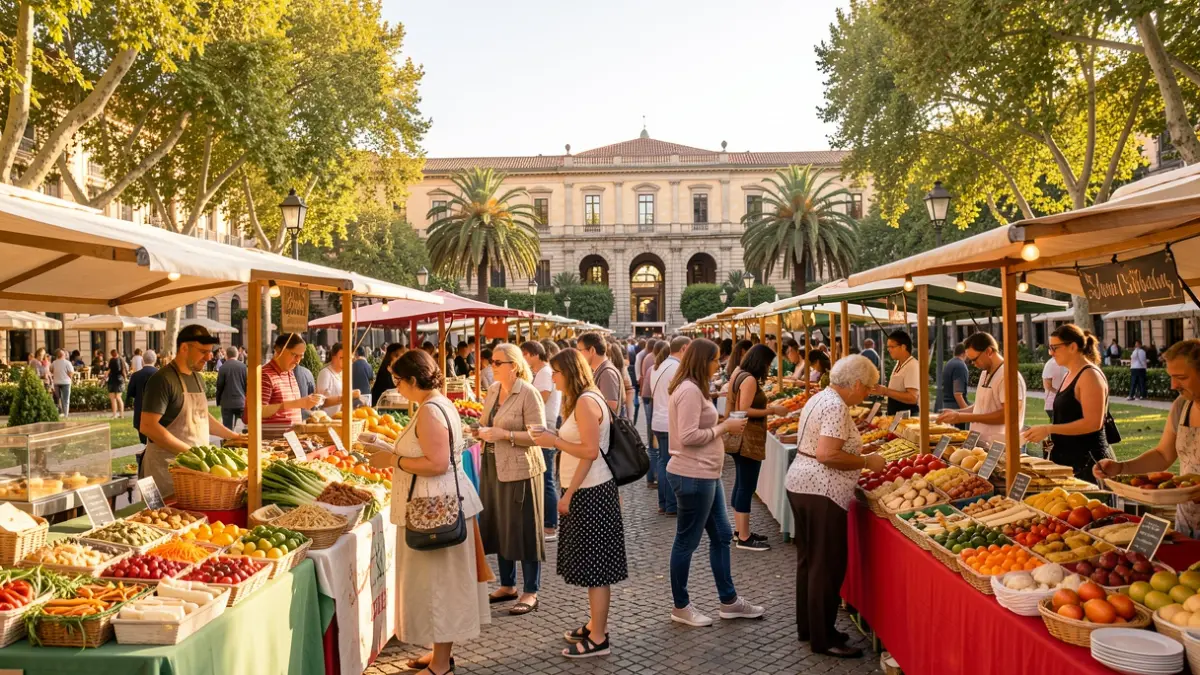
The central Urquinaona Square, located between Ronda de Sant Pere and the beginning of Via Laietana, is a common meeting point in Barcelona. With an urbanized area of over 18,000 square meters, its current name honors Bishop José María Urquinaona Bidot, who, despite being born in Cádiz, had significant integration with Catalonia. He served as bishop of Barcelona between 1878 and 1883, organized the millennium celebrations of Montserrat, and secured the proclamation of Our Lady of Montserrat as the patron saint of Catalonia.
According to Barcelona's nomenclature records, the square was built in 1857 after the demolition of the bastions of Jonqueres and Sant Pere. Initially, it was named Plaça Nova de Jonqueres. Subsequently, it underwent several name changes, including Obispo Urquinaona, Urquinaona, Francisco Ferrer y Guardia, Ferrer y Guardia, Urquinaona, Obispo Urquinaona, before finally adopting the current Catalan name, Plaça d’Urquinaona, in 1982.
Between 1937 and 1939, during the Civil War, the square was named after the pedagogue Francesc Ferrer i Guàrdia. This change, approved in late 1936 and formalized in January 1937, was reversed by Francoism, which reinstated the name of Bishop Urquinaona. The Ferrer i Guàrdia Foundation has documented that the name was given in Catalan during this period.
Francesc Ferrer i Guàrdia, an activist and freethinker, founded the Escola Moderna in Barcelona in 1901. This school, based on freethought, secularism, and co-education, generated strong opposition from the Church and the bourgeoisie. In 1909, after a trial considered irregular, he was executed at Montjuïc Castle, falsely accused of instigating the Tragic Week.
Currently, there are no proposals before the Nomenclature Committee to change the name of Urquinaona Square to Ferrer i Guàrdia. The Ferrer i Guàrdia Foundation unsuccessfully proposed the name for Antoni López Square (now Idrissa Diallo Square) around 2008. The pedagogue currently has a monument on Montjuïc and an avenue named after him.
Bishop Urquinaona is also remembered for laying the first stone of the Sagrada Família in 1882 and for the construction of the Seminari Conciliar de Barcelona in 1879. His defense of protectionist policies in the Spanish Senate earned him the esteem of the Catalan industrial bourgeoisie.
The history of the square is intrinsically linked to the metro. The Urquinaona station opened in 1926 with the second branch of the Gran Metro de Barcelona (current line 4). The original entrance, an iron and glass kiosk demolished in 1972, led to an elevator and a spiral staircase. The Urquinaona station on line 1 opened in 1932. The iron railings and finials from nearly a century ago are still preserved at the entrance on Ronda de Sant Pere and Carrer de Bruc.