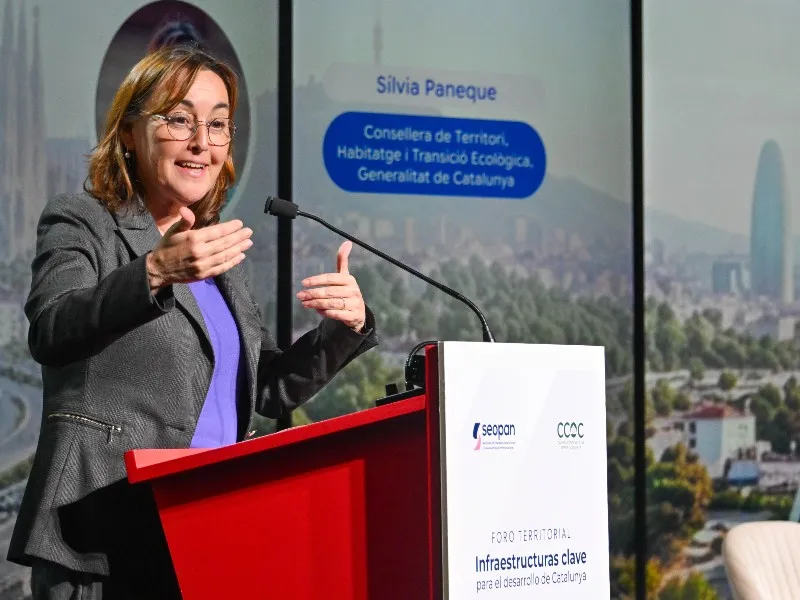
The Minister of Territory, Housing, and Ecological Transition, Sílvia Paneque, on Monday underscored the importance of infrastructure for Catalonia's progress, stating that "investing in infrastructure is investing in our country's productive capacity and, therefore, in the prosperity of Catalonia and our citizens." She made these remarks during the conferences organized by the Chamber of Construction Contractors of Catalonia and the Association of Construction and Infrastructure Concessionaires Companies (SEOPAN), held at the headquarters of Foment del Treball in Barcelona.
Paneque acknowledged Catalonia's tangible structural deficits and presented the Government's roadmap, based on rigorous planning, resource sufficiency, and execution capacity, to "define priorities, ensure investment continuity, and activate instruments to advance projects and translate political action into tangible results".
The minister pointed out that current infrastructure has become outdated due to population growth, which has increased from 6 to 8.2 million people. To address this, the 2026-2036 Infrastructure and Equipment Plan has been approved, with a forecast of 4.3 billion euros, and the 2020-2030 Commuter Rail Plan has been reinforced with an additional 17 million euros. She also mentioned key projects such as the Pyrenean Axis, improvements to the AP-7 and AP-2 connections, rail links for the ports of Barcelona and Tarragona, and the transformation of El Prat airport.
Regarding water infrastructure, Paneque highlighted its direct connection with the country's production centers and supply security. She also mentioned the activation of the decree-law on urgent public procurement measures to favor SMEs and ensure direct payment to subcontractors.
Concerning the energy transition, she emphasized the Government's commitment to energy independence, estimating an annual cost of 10 billion euros due to the lack of sovereignty. Despite acknowledging past missed opportunities in renewables, she noted Catalonia's leadership in battery projects.
On housing, she reported a projected deficit of around 300,000 homes by 2044 and called for public-private collaboration to achieve the goal of promoting 50,000 homes in the first five years.
Finally, Paneque called for a political stability pact to ensure the continuity of long-term investments and concluded by reiterating the Government's commitment to providing efficient administrative and financial tools to build a future of shared prosperity.