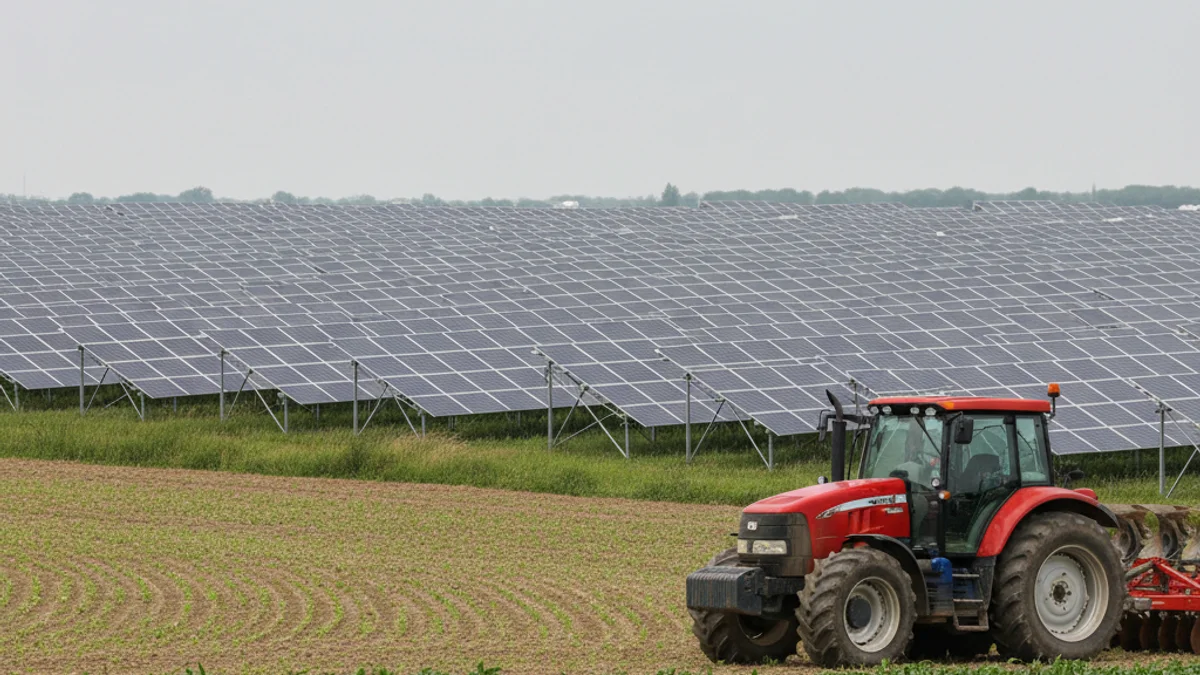
Of the 43 projects challenged, 38 correspond to solar farms and 5 to wind farms, which together would occupy nearly 500 hectares of land, mostly agricultural. The agrarian union reiterated its support for renewable energies but warned that their deployment cannot happen “at the cost of losing agricultural land or expelling farmers from the territory”.
For this reason, the organization advocates that photovoltaic parks should be much smaller, preferably below 10 hectares, located on low agricultural productivity land, and directly involve the local territory. If productive land is occupied, the union demands the application of the Agrarian Spaces Law, a regulation that mandates compensating for lost production by improving neighboring farms.
“"There is a law that specifies that if panels are placed on dryland, the adjacent farm must be improved so that what is stopped producing in one area is gained in the other."
In addition to the allegations against the parks, Unió de Pagesos also filed appeals against 10 authorized photovoltaic projects. Allegations have also been filed against the very high voltage line (MAT) between Cabañera (Huesca) and l’Espluga de Francolí, an 85 km aerial route through agrarian space, affecting up to fifteen municipalities in the Plana de Lleida.
The union insists that the energy transition is necessary but demands that it be carried out with criteria of proximity, territorial balance, and respect for agrarian activity. Since 2019, Unió de Pagesos has filed allegations against 259 solar park projects and 62 appeals.
Another key concern is the pressure on land prices. According to union data, nearly 70% of farmers work on leased land. The entry of large investment funds offering rental prices “unaffordable” for agriculture is causing many professionals to abandon the activity, which is why Unió de Pagesos calls for the local participation of farmers.