This cave, located beneath the municipality of l'Espluga de Francolí and extending to the Mata area, near Riudabella Castle, is a site of great historical significance. It has witnessed the passage of human groups from the Paleolithic to the Roman era, and was even visited in the 12th and 17th centuries. Currently, only 3,590 meters of its vast gallery system have been explored.
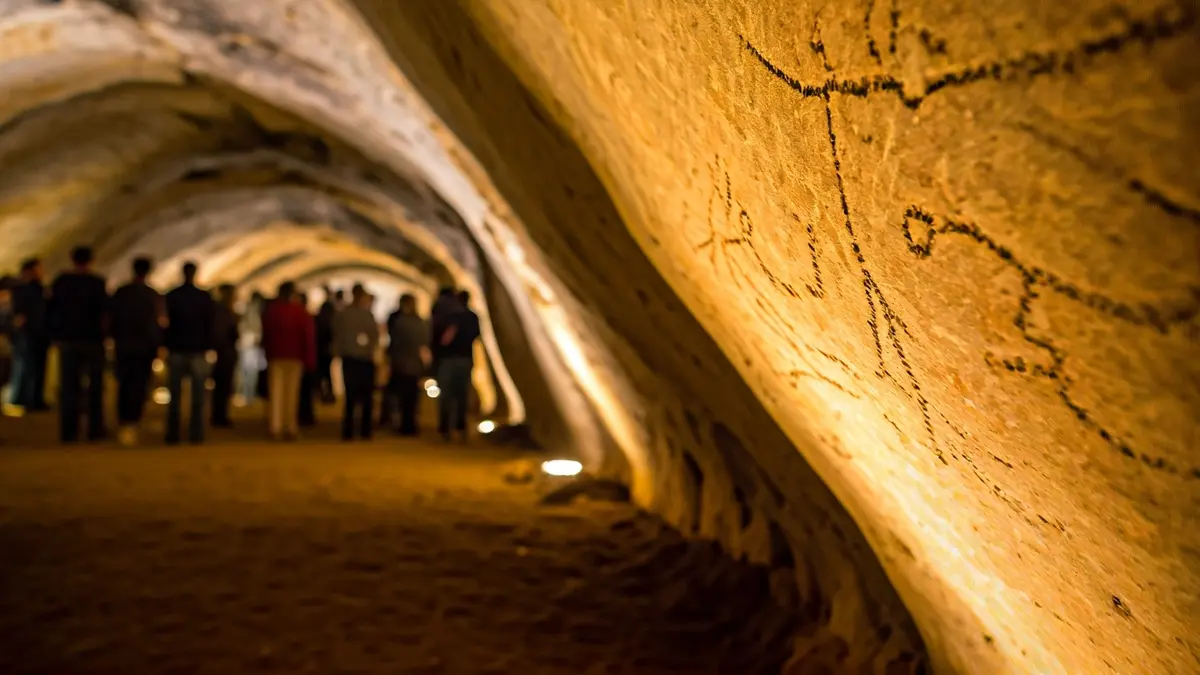
The most significant discovery, which solidified its importance, was that of over 300 Paleolithic engravings in 2019. These engravings, dated between 37,000 and 15,000 years old, constitute the first Paleolithic rock art sanctuary found in Catalonia. This finding was made by Josep Maria Vergès, a researcher at IPHES-CERCA, in the area known as Gatoneres de Cal Palletes.
“"The only difference is that there they are paintings and here they are engravings. If you enter a room full of paintings, you see them immediately. But with engravings, you need a side light."
The Cova de la Font Major is compared to major European caves like Chauvet (France) for the quality and antiquity of its figures. The engravings, which include representations of animals like horses and numerous abstract forms such as spirals and parallel lines, have suffered deterioration over time and from human action. Their authenticity has been verified by elements like stalagmitic growths and carbon studies, confirming human presence during the same chronological period.
In addition to the Paleolithic sanctuary, the cave houses another ritual space in the Sala del Llac, dating from the Iron Age. This site, where the underground river narrows, has revealed offerings such as ceramics with wine, remains of sacrificed animals, and metallic pieces. Researchers believe the cave was a place of spirituality for thousands of years, with rituals possibly related to fertility, as suggested by representations of females and vulvas.
Although Salvador Vilaseca considered the cave archaeologically exhausted in the 1960s, recent discoveries demonstrate its unexplored potential. Researchers, led by Vergès, are searching for new intact galleries using geophysics and ground-penetrating radar techniques. The complexity of the terrain, with a town built above and the presence of utility networks, poses significant challenges for these explorations. Simultaneously, efforts are underway to conserve the engravings through environmental monitoring and to develop outreach projects, such as creating reproductions and virtual reality experiences, as access to the original site is restricted.