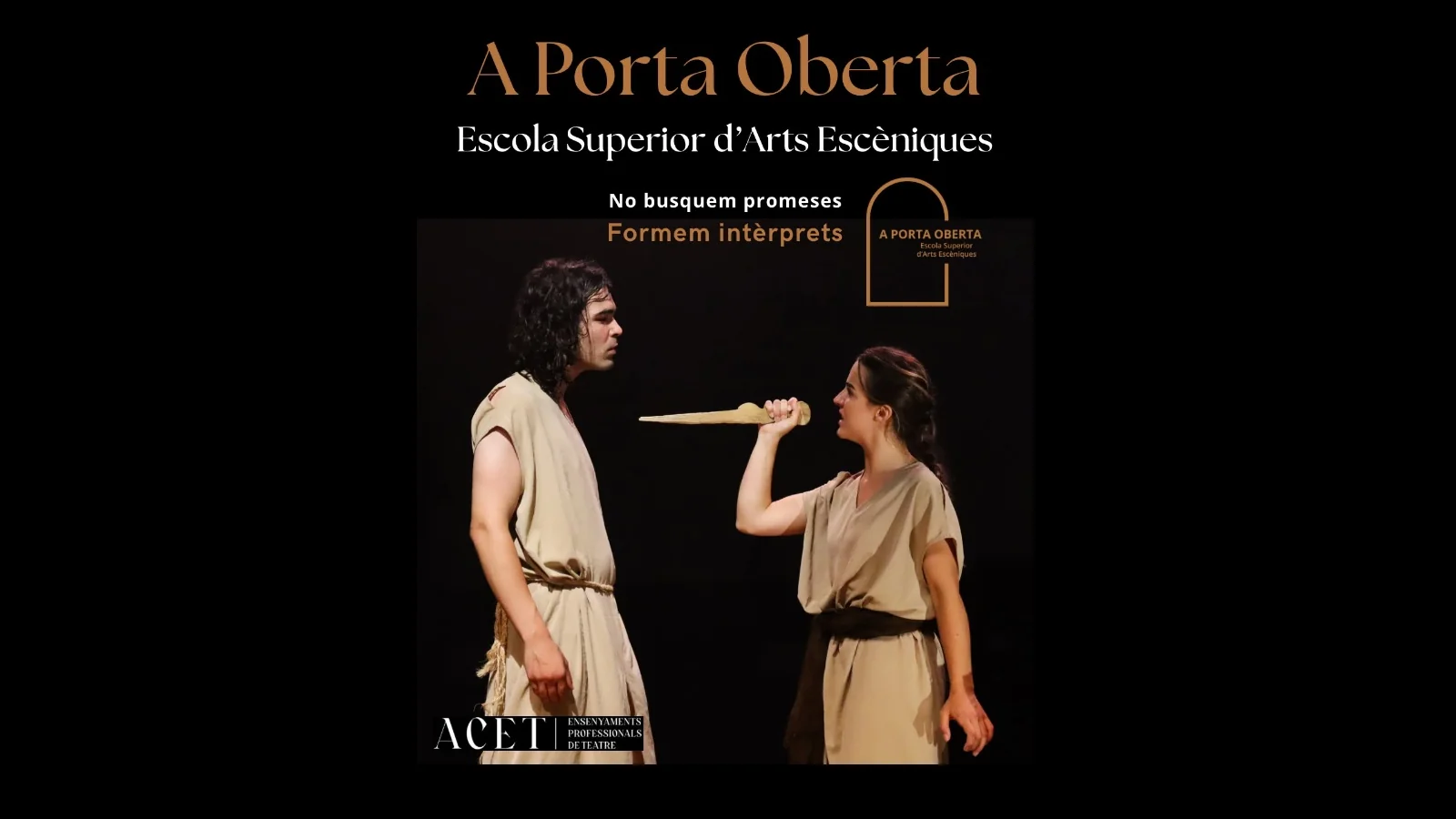
At a time when short courses and intensive workshops are proliferating, A Porta Oberta Escola Superior d’Arts Escèniques defends an idea that seems to go against the grain: an actor is not trained in a few months, but through constant, rigorous, and sustained training over time.
With its own three-year degree and seventeen to twenty hours of work per week, the center has developed a pedagogical project that places the performer's craft at the center of the learning process. Daily stage practice, individualized monitoring, active faculty, and small groups define a training designed to prepare actors and actresses for the demands of contemporary theatre and the audiovisual sector.
The philosophy of A Porta Oberta starts from a clear idea: demanding excellence is only possible when there is a space of trust. Therefore, the work is built on play, collaboration, and respect, fostering a safe environment that allows each student to take creative risks, discover their own voice, and grow both artistically and personally.
The goal is to train performers with a solid acting foundation, capable of adapting to different stage and audiovisual languages. Versatile, committed, vulnerable, generous actors and actresses with great emotional and physical availability; professionals prepared to tackle both classical repertoire and contemporary dramaturgy, stage creation, or camera work.
The uniqueness of A Porta Oberta's pedagogical project lies in the integration of three complementary and dialoguing methodologies.
Acting training develops stage truth, imagination, play, and active listening through improvisations and high emotional performance exercises. Movement, primarily inspired by Jacques Lecoq's pedagogy, places the body at the center of the creative process and explores the relationship between action, space, and text, making the body a true engine of creation.
Added to this journey is the Suzuki Method, created by Japanese director Tadashi Suzuki, an internationally recognized system of physical and mental training. More than an acting technique, it is a discipline that develops stage presence, concentration, and the ability to sustain intense energy before an audience. The work on breathing, grounding, and body control equips performers with a physical and mental solidity that complements the rest of their training.
The combination of these three methodologies allows for the training of complete actors and actresses, capable of thinking, feeling, and acting from a deep awareness of the body, emotion, and relationship with others. A pedagogical approach that turns training into a demanding, yet profoundly transformative experience.
The curriculum is completed with subjects such as Voice, Camera, Theatre History, Dance, and creation processes, forming a comprehensive itinerary that prepares future professionals for both the stage and the audiovisual sector.
"We don't want to train students who simply act a scene well. We want to train artists capable of sustaining a career, of continuing to research, of creating, and of adapting to the challenges of a constantly evolving profession. The actor's craft is not learned solely through talent; it is built with training, discipline, curiosity, fun, play, and a great capacity for work," explain the directors of A Porta Oberta.
In a constantly changing cultural context, training an actor no longer means just teaching them to act, but providing them with the tools to think, create, and evolve throughout their career. It is this long-term vision that defines A Porta Oberta's pedagogical project and its commitment to a new generation of performers.
“"We don't want to train students who simply act a scene well. We want to train artists capable of sustaining a career, of continuing to research, of creating, and of adapting to the challenges of a constantly evolving profession"