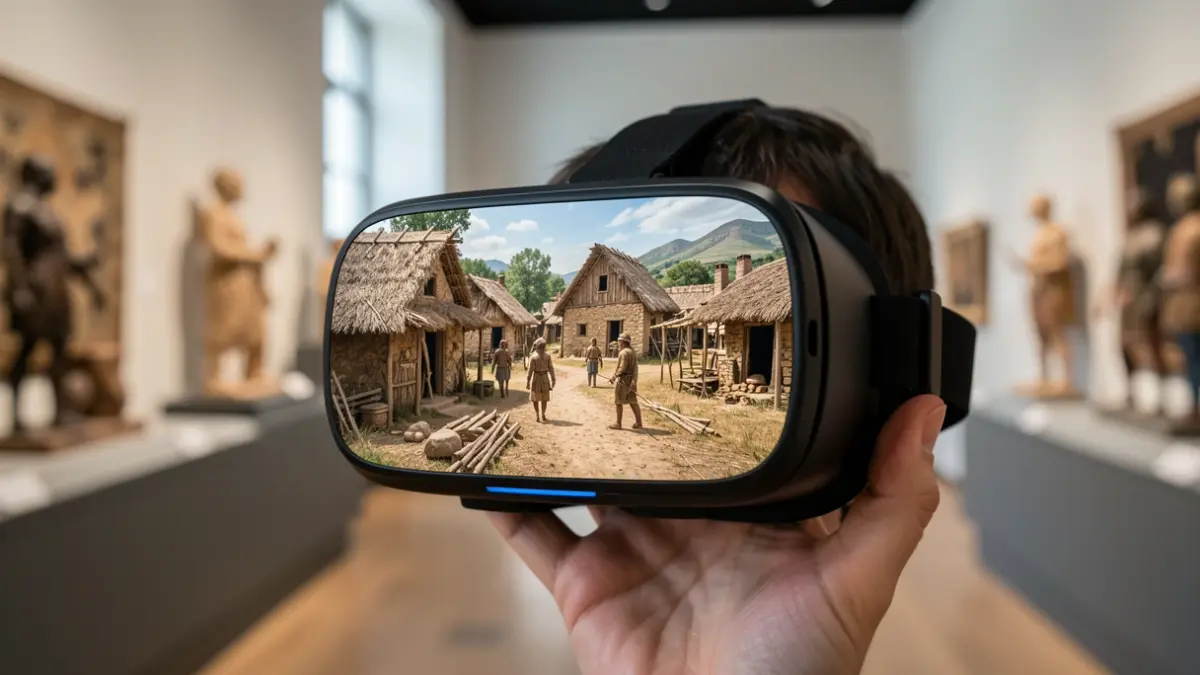
Using virtual reality headsets, visitors can explore the pre-Iberian settlement of Sant Jaume d’Alcanar as it was 2,700 years ago. This experience is based on findings from decades of excavations by the Protohistoric Archaeology Research Group of the University of Barcelona (GRAP-UB). It marks one of Catalonia's first applications of immersive reality to protohistoric sites, with plans for expansion to other locations.
The project, titled Sant Jaume d’Alcanar Immersive. Virtual Journey to the Heart of an Iron Age Fortress, was developed by GRAP-UB in collaboration with the Museum, the Department of Culture, and the Alcanar City Council. It allows visitors to understand the inhabited space between 800 and 500 BCE.
The virtual tour is accessible from the protohistory section of the Museum's permanent Archaeology hall. According to Mar Villalbí, an Archaeology technician and conservator at the Museum, immersive reality effectively helps visitors grasp the spatial reality of the Iron Age settlement, providing a complete view of volumes and heights that might be difficult to visualize on-site.
The Sant Jaume d’Alcanar site is notable for its preservation. After 26 excavation campaigns, GRAP-UB has uncovered a remarkably intact settlement on a hill, featuring substantial walls. Its destruction by fire caused the settlement to collapse inwards, preserving numerous architectural remains.
Discoveries suggest the presence of a stable Phoenician colony on the Ebro coast, further north than previously believed, and a century and a half before the Greeks arrived in Roses. David Garcia, excavation director, posits that the site could have been a Phoenician trading post or the residence of a local chieftain, shedding light on interactions between newcomers and the indigenous population.
Museum director Elena Fabra highlights that the immersive reality project expands the Museum's offerings, enhances visitor experience, and attracts new audiences, particularly young people, who are more readily engaged with archaeological heritage through new technologies.
Villalbí adds that this technology speaks the language of younger generations, who have grown up with visual media and decode it more rapidly, making the visualization of high walls and the settlement's structure more comprehensible.
The Museum will assess public reception of the experience to consider extending the project to other protohistoric archaeological sites in the region, as noted by Fabra, in collaboration with GRAP-UB. The initiative received a grant of 5,649 euros from the Department of Culture and an additional 4,000 euros from GRAP-UB.