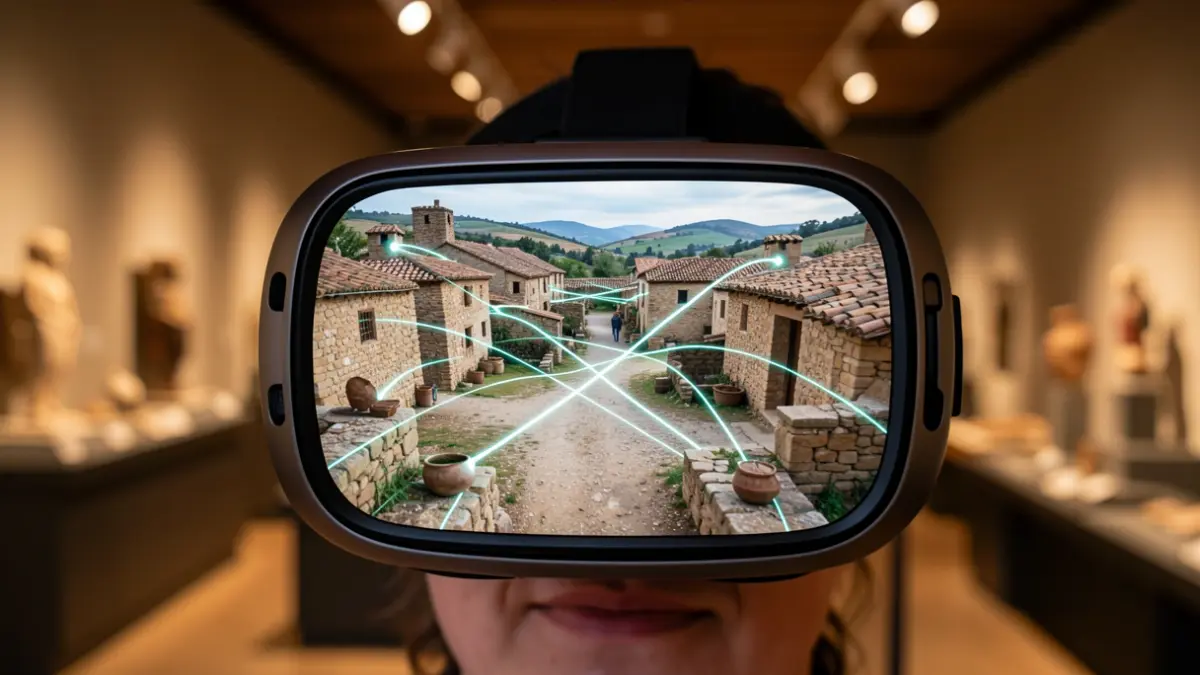
By introducing an immersive experience, the Museu de les Terres de l'Ebre aims to highlight local protohistoric sites and, crucially, capture the attention of adolescents. The use of virtual reality headsets transforms the visit, allowing users to explore the pre-Iberian settlement of Sant Jaume d'Alcanar as it existed 2,700 years ago.
This reconstruction is based on extensive research by the Protohistoric Archaeology Research Group of the University of Barcelona (GRAP-UB), which has been excavating the site for decades. This initiative is among the first applications of virtual immersion in Catalan protohistoric settlements, and the museum plans to expand it to other similar sites in the region.
The proposal allows visitors to access a virtual recreation of an Iron Age fortification. Mar Villalbí, an archaeology technician and conservator, explains, "You can see volumes and heights. If you go to the site, you can see the height (of the walls), but here you see it finished, you get a better idea of what it might have been like because sometimes it's complicated."
The Sant Jaume d'Alcanar site is unique due to its preservation. With 26 excavation campaigns, GRAP-UB researchers have recovered a remarkably complete settlement on a hill, with walls that retain significant height. Villalbí notes that "it's a very unique site that has been preserved very whole." The fire that caused its destruction caused it to collapse inwards, preserving many remains.
The located remains could be the first evidence of a permanent Phoenician colony on the Ebro coast, much further north than previously thought and predating the Greek presence in Roses and Empúries. David Garcia, director of the excavations, suggests that, based on the objects found, the site could correspond to a Phoenician factory or even the residence of a local chief, allowing for the study of interactions between arriving settlers and local communities.
Elena Fabra, the museum's director, emphasizes that this initiative "means expanding the offering and improving the visitor experience, as well as reaching a wider audience." Adopting these technologies can facilitate access to local archaeological heritage, especially for young people who typically show little predisposition to participate. According to the museum, introducing digital formats "makes it easier."
The visual codes of current generations help them better understand this content. Villalbí remarks that it's a way to bring it closer to everyone because "it's often difficult for people to understand that there were high walls based on the remains." With young people, "you're speaking their language," as they have grown up "primarily with images and decode them more quickly."
The virtual tour takes place in the permanent Archaeology hall. The museum will evaluate public response to consider bringing the experience to other protohistoric archaeological sites in collaboration with GRAP-UB. Management states that "the idea is to grow and add more immersive reality experiences."
The initiative was made possible by a 5,649 euro grant from the Department of Culture for cultural projects based on immersive technology and a 4,000 euro contribution from GRAP-UB itself.