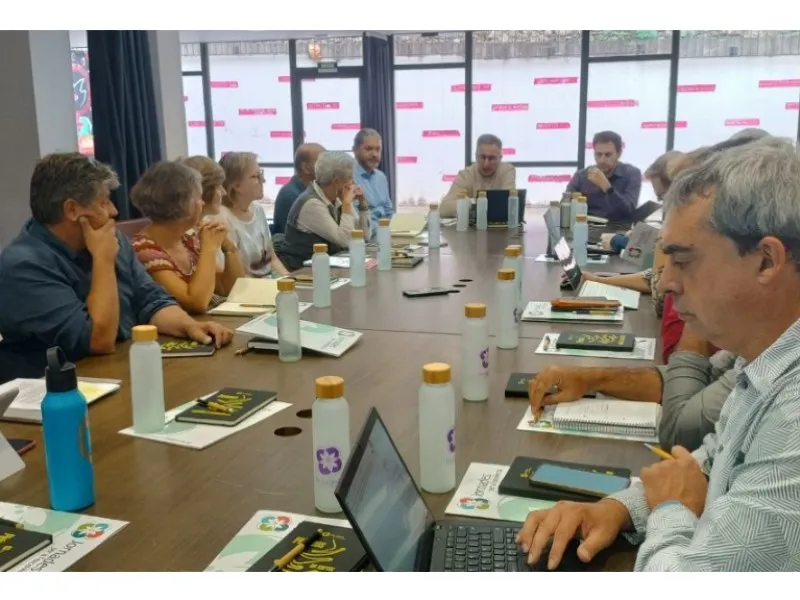
Representatives from 21 municipal entities, associations, consortia, companies, and the Department of Territory, Housing, and Ecological Transition established the Mobility Table for Alt Pirineu and Aran today in Esterri d’Àneu. This new body will serve as a stable space for coordination and shared work among stakeholders involved in mobility within this territory, launching as part of the XIII Excellence Conference 2026, themed Pyrenees Networked: Mobility and Connectivity.
The Table's primary objective is to share information, knowledge, and experiences, as well as to analyze the mobility needs and challenges of the Alt Pirineu i Aran. Factors such as low population density, dispersed settlements, complex orography, and strong seasonality create a unique mobility reality requiring tailored solutions.
According to the Daily Mobility Survey, private transport accounts for 50.4% of trips, active modes for 44.8%, and public transport for only 4.8%. The forthcoming Master Mobility Plan will define a strategic vision for future policies, while the ATM of Lleida already provides an integrated fare system.
The Table will address both internal mobility within the territory and its connectivity with the rest of Catalonia, aiming to identify improvement opportunities and shared proposals. It will meet quarterly and can establish working groups. IDAPA director David Vallvé emphasized that the table will be a tool for gathering and conveying the region's specific needs and challenges.
Director General of Mountain Policies, Carlos Guàrdia, recalled that the Pyrenean Strategy aims for a distinct Pyrenean mobility model. Director General of Transport and Mobility, Susi López, highlighted the commitment to a more sustainable, accessible, and connected mobility system, reinforcing public transport's role.
Technical coordination will be handled by the Association of Rural and Maritime Initiatives of Catalonia (ARCA), in collaboration with IDAPA. The Table includes representatives from the Department of Territory, FGC, the ATM of Lleida, the county councils of Cerdanya, Alt Urgell, Pallars Jussà, Pallars Sobirà, and Alta Ribagorça, the Conselh Generau d’Aran, along with various associations and municipalities. Its composition remains open to new stakeholders.