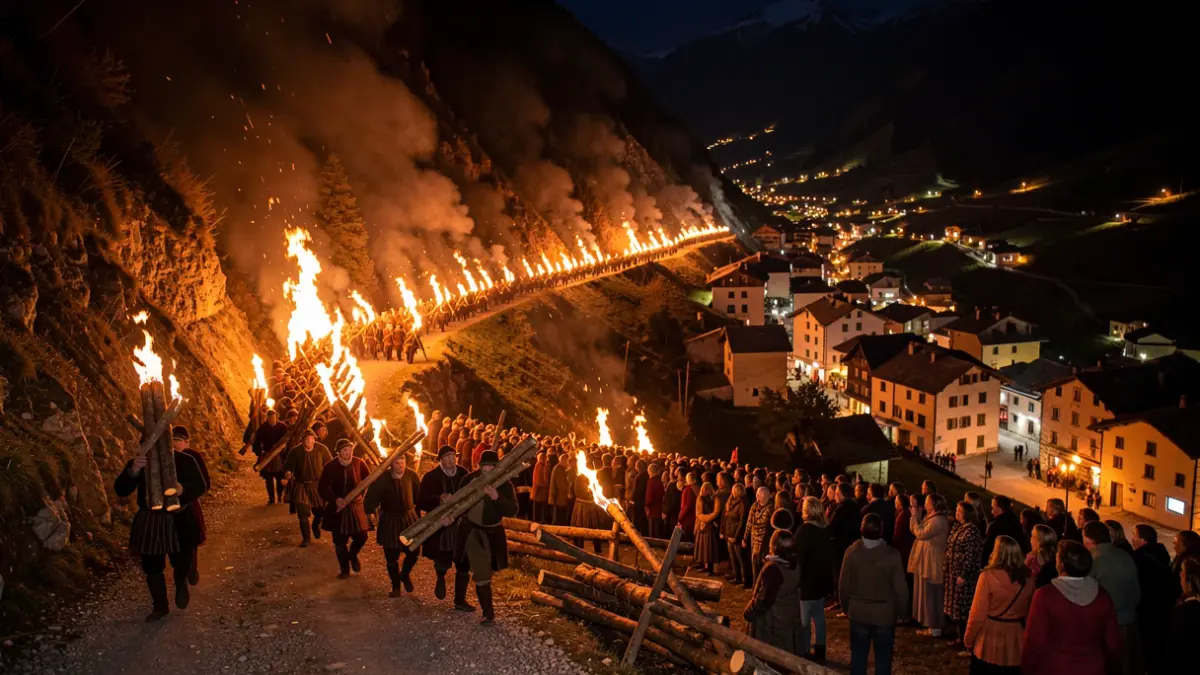
On Tuesday night, the village of Isil, located in Alt Àneu, hosted its ancestral fire festival. This tradition brings together about sixty residents from the village and surrounding areas, and is considered one of the most impressive in the Pyrenees due to the size of the logs used and the challenging mountain route.
As darkness fell, the lighting of the main 'falla' (log) in the square marked the event's commencement. From the mountain's summit, participants began their descent, transforming the line of burning logs into a spectacular 'serpent of fire' winding down a steep, unmarked path, illuminated solely by the flames. The logs, some weighing over 50 kilograms, were carried by the 'fallaires' (log bearers) down to the village, where hundreds of spectators awaited.
Historically, tradition dictated that all leftover logs from the mountain had to be burned. However, currently, around ten logs are specifically prepared for the celebration. Despite their exhaustion, participants were welcomed in the village with wine, 'coca' (a sweet bread), and a bouquet of flowers as a token of appreciation for keeping the festival alive.
“"The mountain grass was very dry and caught fire, cutting the line, although the fallaires regrouped further down."
This year's descent was described as one of the most demanding. According to Mireia Mandicó from the Isil Fallas Association, dry grass on the mountain caused a small fire that temporarily disrupted the procession, though the participants managed to regroup. 'Fallaire' Guillem Esteban highlighted the night's hardship, noting that the last reserves of strength are saved for reaching the cemetery, where three crosses are made on the gate in memory of deceased fellow 'fallaires'.
This celebration holds dual official recognition. The Generalitat de Catalunya declared it a Traditional Festival of National Interest in 1991. Subsequently, in December 2015, the Isil Fallas were inscribed as Intangible Cultural Heritage of Humanity by UNESCO, sharing this distinction with two other log descents in the Pallars region: those in Alins and La Pobla de Segur.