The Catalan Renewable Energy Sectoral Territorial Plan (PLATER), currently in public exhibition, has sparked controversy in Priorat. While the plan assigns wind power quotas to municipalities that do not want them, others such as Margalef, Cabacés, and La Bisbal de Montsant are demanding an increase in their quota. The Priorat County Council urges the Generalitat to prioritize municipalities with 'interest' and warns that the plan also envisages the installation of wind turbines in the future Parc Natural de les Muntanyes de Prades, Poblet i la Serra de la Llena.
PLATER, which aims to regulate the implementation of renewable energies and rebalance photovoltaic and wind power plants, has led to complaints in various Catalan regions. In Priorat, several municipalities will submit objections. While there is general agreement on photovoltaic energy, discrepancies arise with wind power, as most municipalities do not want wind turbines, whereas Margalef, Cabacés, and La Bisbal de Montsant desire a higher quota than allocated.
The president of the Priorat County Council, Sergi Méndez, emphasizes the importance of the county plan developed by the County Office for Energy Transition, stating that 'coordinated work has been done which we believe should be reflected.' He regrets that interested municipalities lack quotas while others, without initial interest, possess them.
PLATER sets a target of 567.5 MW of wind power production for Priorat by 2050. Cabacés is allocated 22.5 MW, La Bisbal de Montsant 27.9 MW, and Margalef only 1.2 MW. The municipalities most affected by the proposal are Cornudella de Montsant (88.8 MW), Falset (49.1 MW), Pradell de la Teixeta (45.1 MW), and La Morera de Montsant (38.4 MW).
Méndez proposes that municipalities without interest could 'transfer their quota' to those that do. He points out that the three towns wanting more wind turbines are located in the northwest of Priorat and already have wind farms nearby, which would facilitate an expansion to create a 'territorial continuum'.
The Priorat renewable energy plan, developed in 2024, already defined 'suitable' areas with 'moderate' impact, proposing 25 MW for La Bisbal de Montsant, 25 MW for Margalef, and 10 MW for Falset.
In Margalef, with only 1.2 MW assigned by PLATER, Mayor Àlex Vila considers the power 'very limited.' Despite limitations due to protected areas like Xarxa Natura 2000 and the Parc Natural de la Serra de Montsant, Vila notes that regulatory changes for the protection of the Bonelli's eagle could facilitate the construction of wind farms. He argues that the town's mountains are 'competitive' due to the amount of wind hours and the proximity of the Les Rotes wind farm in Les Garrigues already creates a visual impact.
Vila requests that the territory's will be included in PLATER, highlighting the importance of renewables and the fiscal benefits for small municipalities. 'The taxes collected from a wind farm in a town of a hundred inhabitants are tools that help you move forward,' he states.
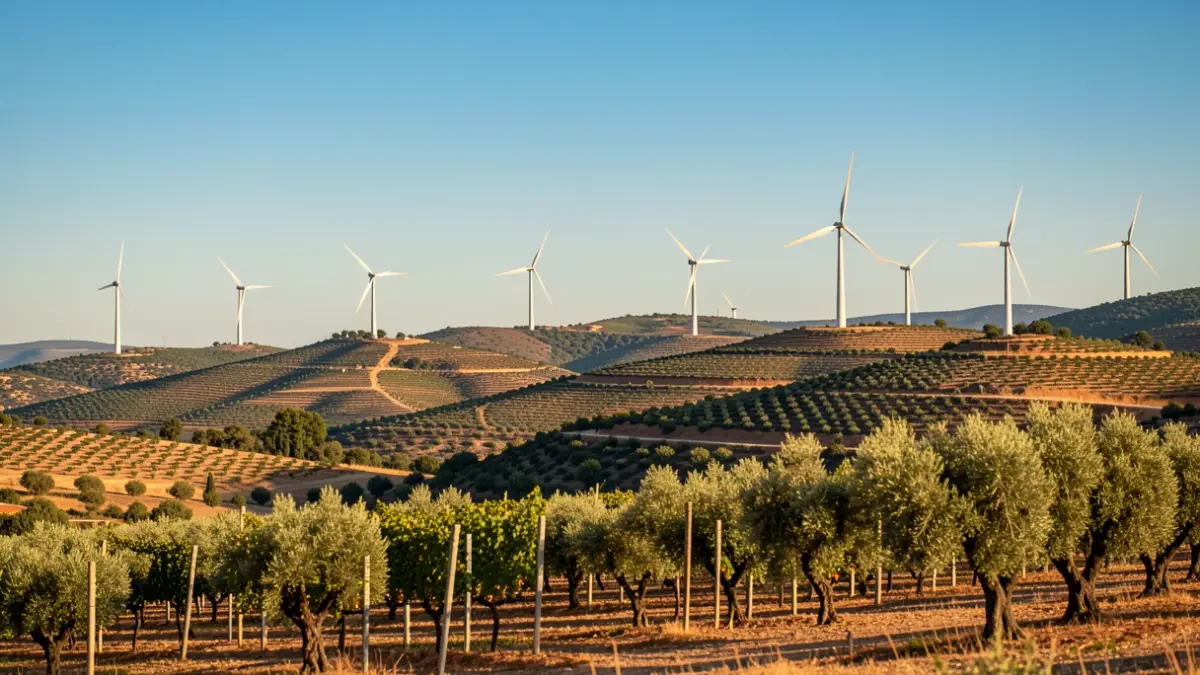
Historically, Priorat experienced less impact from the first wave of renewable energy compared to neighboring regions, coinciding with the region's bid for UNESCO World Heritage status. Currently, Priorat has 45 wind turbines totaling 22.09 MW, 30 of which are in Pradell de la Teixeta. PLATER anticipates a production 400% to 700% higher than the region's consumption, which Méndez deems 'unjust and unbalanced'.
The president of the County Council recalls that Priorat already produces 50% more energy than it consumes and calls for the implementation of renewables to first address local consumption needs.
Àngel Cortadelles, president of Prioritat, warns that wind farms could 'seriously affect the values of the World Heritage candidacy' due to landscape impact. He criticizes PLATER for not considering 'the social aspect, the will of the people,' and frequent power outages, urging for the prioritization of supply quality over 'damaging values indispensable for the primary sector and territorial preservation'.
The delimitation of suitable areas for wind turbines within the future Parc Natural de les Muntanyes de Prades, Poblet i la Serra de la Llena also causes discontent. Although sources from the Department of Territory and Ecological Transition suggest the area will be ruled out once the natural park is approved, PLATER does not explicitly prohibit construction within these areas.
The draft decree for the Natural Park limits installations to 30 kV for power lines and production plants. Only renewable energy plants for agricultural or livestock facilities or communities without alternatives will be admitted, with maximum capacities of 100 kW and 0.5 ha for photovoltaic, and 30 kW and 15 meters for wind.