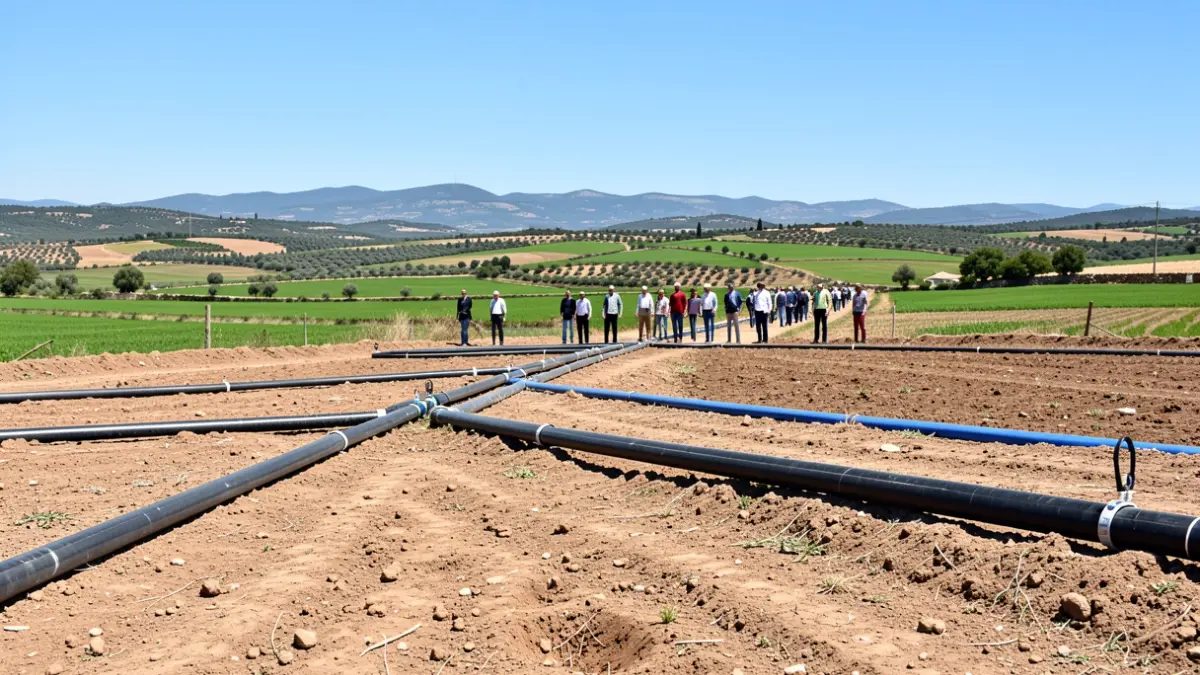
The Department of Agriculture of the Generalitat has completed the expansion works for the Vingalis irrigation area in the Serra del Rovelló, Ribera d'Ebre. 90.6 hectares of irrigated land have been incorporated, out of the initially planned 124.4 hectares, corresponding to the farms that have formalized their adhesion payment to the Irrigation Community.
The incorporated area is distributed among the municipalities of Flix (1.87 ha), Vinebre (63.30 ha), and La Torre de l'Espanyol (25.40 ha). The execution budget for the works slightly exceeded one million euros. The Department of Agriculture will finance 85% of the investment, while the remaining 15% will come from the Nuclear Transition Funds, contributed by the Irrigation Community.
These actions are part of the Irrigation Strategy 2025-2040, which plans an investment of 3.090 million euros by 2040 to modernize and expand irrigation across Catalonia, affecting nearly 181,000 hectares.
The Minister of Agriculture, Òscar Ordeig, highlighted the importance of these actions for the future of the agricultural sector, increasing farm competitiveness, and strengthening the territory's capacity to face climate change.
The original project for the Serra del Rovelló dates back to 2010 but was never executed. Its revival was prioritized after the major fire in Ribera d'Ebre in 2019, which burned approximately 5,000 hectares.
Additionally, the Vingalis Irrigation Community has received 41,000 euros in grants to modernize its facilities, including upgrades to electrical panels, wiring, pumps, and remote control systems.
During the same day, Minister Ordeig visited the solar park in Benissanet, which now serves its Irrigation Community and irrigates 352 hectares. The installation, comprising 900 photovoltaic modules, has an estimated annual production of 1,017 MWh and represents an investment of 1,217,000 euros, financed 70% by the Department and 30% by the Irrigation Community (using Nuclear Transition Funds).