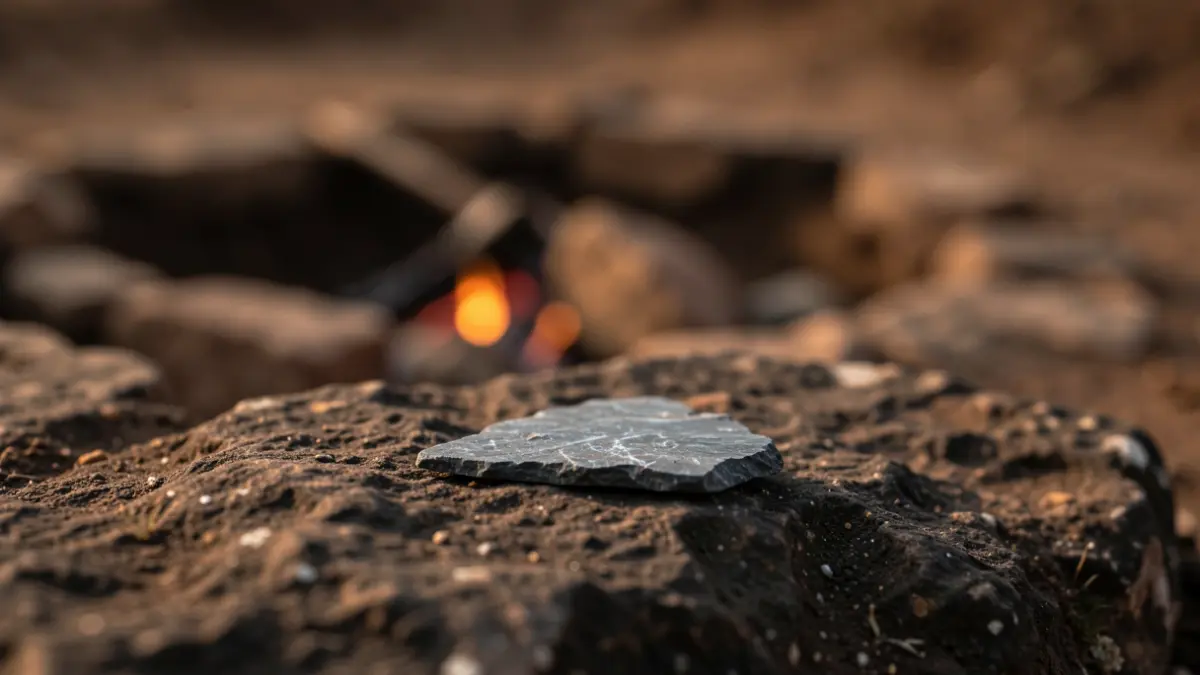
A recent excavation campaign at Tut de Fustanyà, a cave located in Queralbs (Ripollès), has confirmed human occupation despite initial expectations of finding the site heavily looted. The team of archaeologists from IPHES-CERCA has located remains of a small hearth and a flint projectile point, dating human activity to a key period, between 42,000 and 39,000 BC.
These findings date from the end of the Pleistocene, an era marked by the coexistence of the last Neanderthals and the arrival of the first Homo sapiens. According to Carles Tornero, a prehistory professor and head of the work, the site represents a "window into the oldest chronology" of human presence in the Ripollès region.
The campaign, part of the project Arrels prehistòriques de la transhumància a l'Alt Ripollès (Prehistoric Roots of Transhumance in Alt Ripollès), took place from June 8th to 21st, following site preparation the previous year. The flint artifact, described as "very characteristic of the late Neanderthal period," was found in an area considered "intact" regarding human occupation.
The site also stands out for the presence of fossil remains of extinct animals that lived in extreme climatic conditions, such as the cave bear, hyena, horse, and notably, the mountain leopard. Tornero points out that Tut de Fustanyà may have been an important habitat and breeding ground for this feline species, which is "uncommon in fossil records."
This strategic location, supported by the Conselleria de Cultura, the Ajuntament de Queralbs, the Parc Natural de les Capçaleres del Ter i Freser, and the UAB, will help complete the cross-sectional view of prehistory in the Capçaleres del Freser. The research has been extended for another four years.
Concurrently, excavation has continued at the Roc de les Orenetes site, also in Queralbs. This prehistoric burial ground, located at over 1,800 meters altitude, contains thousands of human remains dated between 2,400 and 2,200 BC. The concentration of bones, described as a "carpet of bones," has been particularly high in the area excavated this year.
The recovery of remains at Roc de les Orenetes involves a complex process of photographic documentation and digital reconstruction to individualize and analyze each piece, precisely fixing its coordinates. Last year, a flint arrowhead embedded in an adult rib bone was discovered, an exceptional piece of evidence of interpersonal violence over 4,000 years ago in the Catalan Pyrenees.