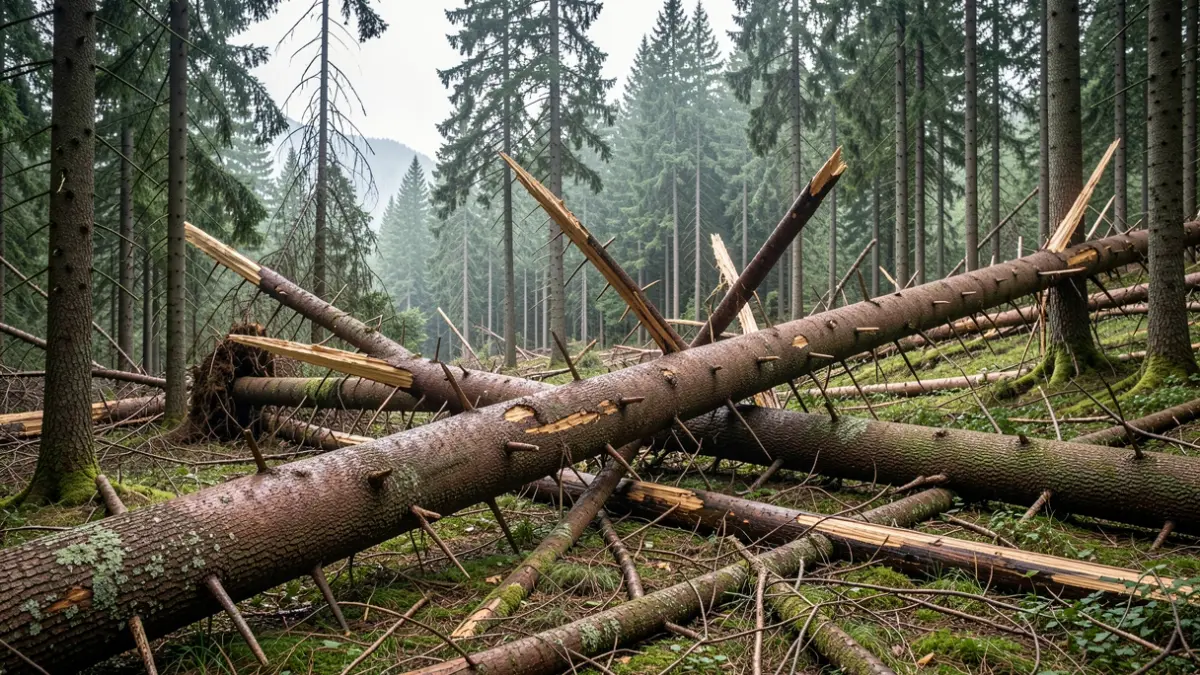
Specialized companies have been working intensively since mid-June to remove trees felled by windstorms in February, March, and April. Initially, an impact of 260 hectares of public forest in Pardines and Setcases was estimated, but a new calculation by the Government has raised the affected area to approximately 750 hectares. These areas are spread across 21 municipalities in the region, including Campdevànol, Campelles, Llanars, Planoles, Queralbs, Ribes de Freser, Toses, and Vilallonga de Ter, along with three areas owned by the Generalitat.
The volume of fallen timber to be removed in Ripollès has increased from 14,700 tons to around 40,000 tons. According to Tània Giró, a forestry engineer for the Department of Agriculture in the region, the report is not yet final and more affected areas may emerge, as land less than one hectare or with less than 20% of trees affected has not been counted.
Currently, work is underway in all municipalities except Campdevànol, where the impact is minimal. The 41 distinct zones allow companies to use the most suitable machinery for each type of product. The goal is to complete the tasks before November 1st, coinciding with the onset of bad weather and snow.
In Pardines and Setcases, the awarded companies retain the timber as compensation for their work. In Vilallonga de Ter, the Generalitat has invested nearly 48,000 euros to open over two kilometers of new road providing access to the most affected area, Bac d'Abella.
Giró also notes that local councils have suffered significant financial losses, as the value of fallen timber has depreciated considerably and extraction costs are higher. Furthermore, cases of incivility have been detected during the summer, with parking prohibition signs painted over or broken, which she attributes to a lack of information about the tree removal operations.
Vilallonga de Ter is the most affected municipality, with approximately 220 hectares devastated. The mayor, Pere Sau, estimates that the cleanup is progressing well, with 60-70% of the area already cleared, although he anticipates the work will extend until December 31st.
Once timber removal is complete, the forest management of the affected areas will be re-evaluated, considering natural regeneration or conversion to pastureland, which offers benefits such as increased biodiversity and reduced fuel load in case of fire.