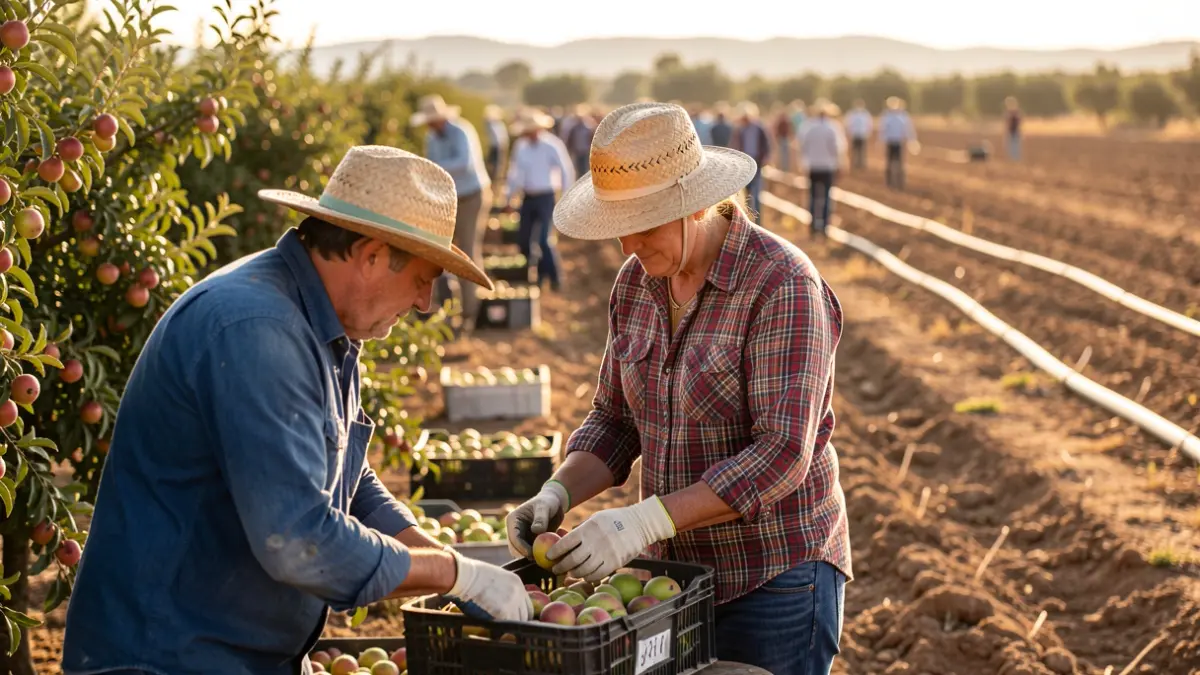
In response to an intense heatwave that could register temperatures up to 43 degrees Celsius, fields in the Lleida plain have implemented changes to the work schedules of seasonal laborers. The primary objective is to minimize exposure during peak sun hours and ensure the well-being of those involved in harvesting sweet fruit.
According to Sergi Balué, head of the sweet fruit sector at JARC and a farmer, workdays now begin at six in the morning and extend until two in the afternoon in an intensive format. If temperatures become excessively high, the option to split the workday or halt operations is considered. This adaptation is being carried out on farms growing Paraguayan peaches, such as one located in Los Alamús, in the Segrià region.
“"The priority is to preserve the health of our workers. If a point is reached where temperatures are extreme and work must stop, then it stops."
Agricultural farms are providing workers with cool water, sunscreen, and hats to mitigate the risks associated with extreme heat. Balué emphasizes the importance of employee health, noting that both managers and workers share this concern.
The farmer warns that these episodes of intense heat are becoming increasingly frequent in the region, shifting from occasional events to near-daily occurrences. In response to this climatic trend, the sector is considering new adaptation measures, such as using anti-hail nets to protect fruit from the sun, applying specific products to prevent sunburn on the fruit, and introducing more heat-resistant crop varieties.
Regarding current production, Balué indicates that Paraguayan peaches are showing good adaptation to the climatic conditions, increasing their sugar levels and maintaining excellent quality as long as water is available. He calls for maximum caution, reminding everyone of the need to ensure hydration and sun protection, and to act swiftly if any symptoms of heatstroke appear, seeking medical attention.
Totto Mukulu, originally from the Democratic Republic of Congo and a resident of Catalonia for ten years, positively assesses the schedule adjustment. "It's tough, but we start early, and if it's very hot in the afternoon, we stop," he explains, noting that it's not the first year they've worked in such temperatures and that necessary measures like water and sunscreen are provided.
Mukulu also comments that wearing long-sleeved shirts and trousers, while seemingly counterintuitive, is essential for protecting the skin from dust and potential irritations from the trees during sweating.
Finally, Balué highlights that the availability of labor for the agricultural campaign in Ponent is balanced thanks to regularization processes, meeting the sector's personnel needs without surplus or shortage.