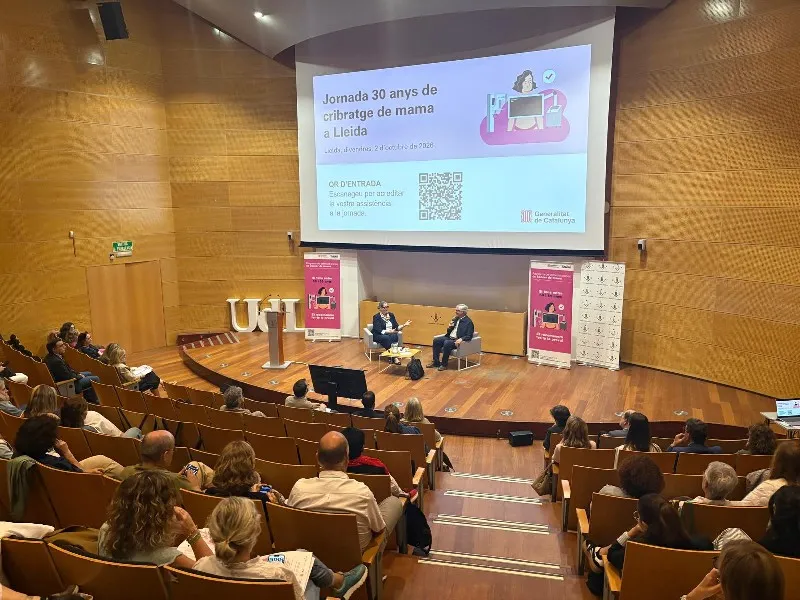
The event, held in Lleida, served to analyze the program's achieved impact, future challenges, and recognize the work of professionals and entities involved. The manager of the Lleida Health Region, Rosa Maria Pérez, defined the program's 30 years as a collective history of effort and commitment. She emphasized that, despite the region's extensive geographical reality and high aging index, participation in breast cancer screening reaches 85%, one of the highest in Catalonia. Pérez highlighted the program's equity, noting that half of the detected cancers come from mammograms taken with the mobile mammography unit.
Josep Alfons Espinàs, coordinator of the Cancer Screening Office of the Department of Health, valued the involvement of health regions in early detection and presented the strategic vision for screening in Catalonia, anticipating how scientific, technological, and organizational advances will shape the program's future.
Montse Llorens, coordinator of the Technical Office for the Early Detection Program for Breast and Colorectal Cancer, reviewed the figures: 294,116 mammograms performed, 12,412 additional tests, and 1,314 cancers detected, mostly in early stages. She highlighted the work to achieve high participation and acknowledged current challenges such as population increase and the cultural diversity of new arrivals.
The event also included presentations on breast interventionalism in screening, by Mercè Reñé, Head of Section of the Diagnostic Imaging Service at the Arnau de Vilanova University Hospital (HUAV). The medical team from the HUAV Breast Unit, including Jordi Melé, Serafin Morales, and Ariadna Gasol, discussed the impact of screening on the de-escalation of surgical and oncological treatment.
The closing panel featured the personal testimonies of three women who have had breast cancer, emphasizing the importance of early detection through the Association Against Cancer.
The program, an initiative of the Department of Health, is carried out in the Lleida Health Region through Gestió de Serveis Sanitaris, in collaboration with the Institut Català de la Salut and Clínica Mi NovAliança. Women between 50 and 69 years old are invited for a mammogram every two years, using two radiological units: one at the Clínica Mi NovAliança and an itinerant mobile unit.