Researchers from RMIT University will join the nature-based solutions project underway at the Rubí stream, located in the Vallès Occidental region. This collaboration is part of the AuSpire doctoral and postdoctoral training program under the Marie Skłodowska-Curie Actions (MSCA), coordinated by RMIT Europe. Initially, a postdoctoral researcher from the Australian university will join the «Water for Life» project team, led by IDAEA-CSIC, CEAB-CSIC, and Naturalea.
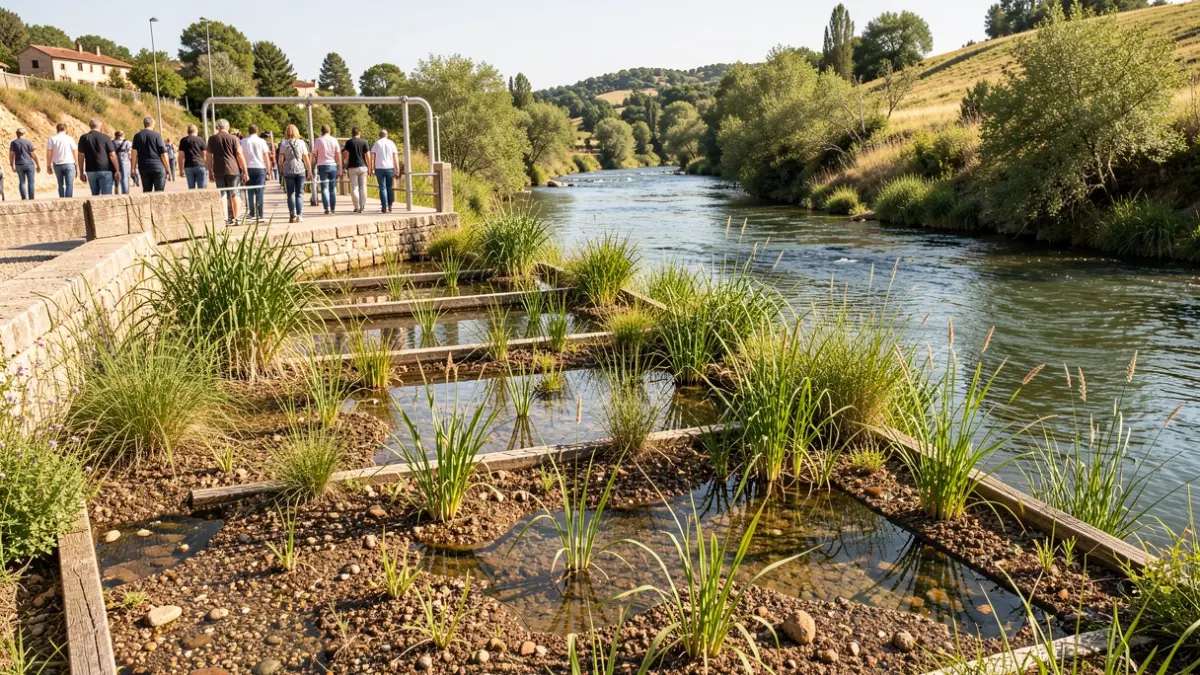
The researcher will contribute to the scientific evaluation of the implemented actions and the study of their applicability in other areas. The «Water for Life» project, driven by the Catalan Water Agency (ACA), the Consell Comarcal del Baix Llobregat, the CSIC, and AstraZeneca, involves creating an artificial wetland area downstream from the wastewater treatment plant (EDAR) in Rubí. This initiative will provide complementary natural purification for treated water before it is returned to the stream.
These wetlands utilize native plants, microorganisms, sediments, and novel materials to reduce chemical and biological contaminants resistant to conventional methods. The objective is to return higher quality water to the stream to restore habitats, biodiversity, and ultimately, ecological health. The project also aims to identify the most efficient natural combinations for different contaminants and study the applicability of these solutions in other urban streams and rivers.
The agreement strengthens scientific cooperation between Catalonia and Australia, two regions facing common challenges related to water availability and climate change. Alec Cameron, Vice-Chancellor of RMIT University, highlighted the importance of collaborations for research and sustainable innovation, and positively valued the contribution of expertise in water quality.
Rosemary Morris-Castico, Australia's Ambassador to Spain, emphasized the significance of projects like «Water for Life» in reminding us of our commonalities, particularly the awareness of water's importance and healthy ecosystems. She noted that combining expertise can generate valuable knowledge for environmental restoration.
Marta Moreno, Vice President of AstraZeneca Spain, stated that environmental challenges require new forms of collaboration and the pooling of capabilities. She affirmed that the project unites scientific knowledge and local action to improve natural resource management, generating evidence for its application in other environments.
Ethel Eljarrat, Director of IDAEA-CSIC, pointed out that the project exemplifies success when administrations, companies, and research centers collaborate. She stressed that water management is a global issue that transcends borders, making international cooperation essential.
Marc Rius, Director of CEAB-CSIC, added that the project is crucial for water preservation in ecosystems facing increasingly extreme conditions, and that the current climate situation necessitates international scientific solutions.