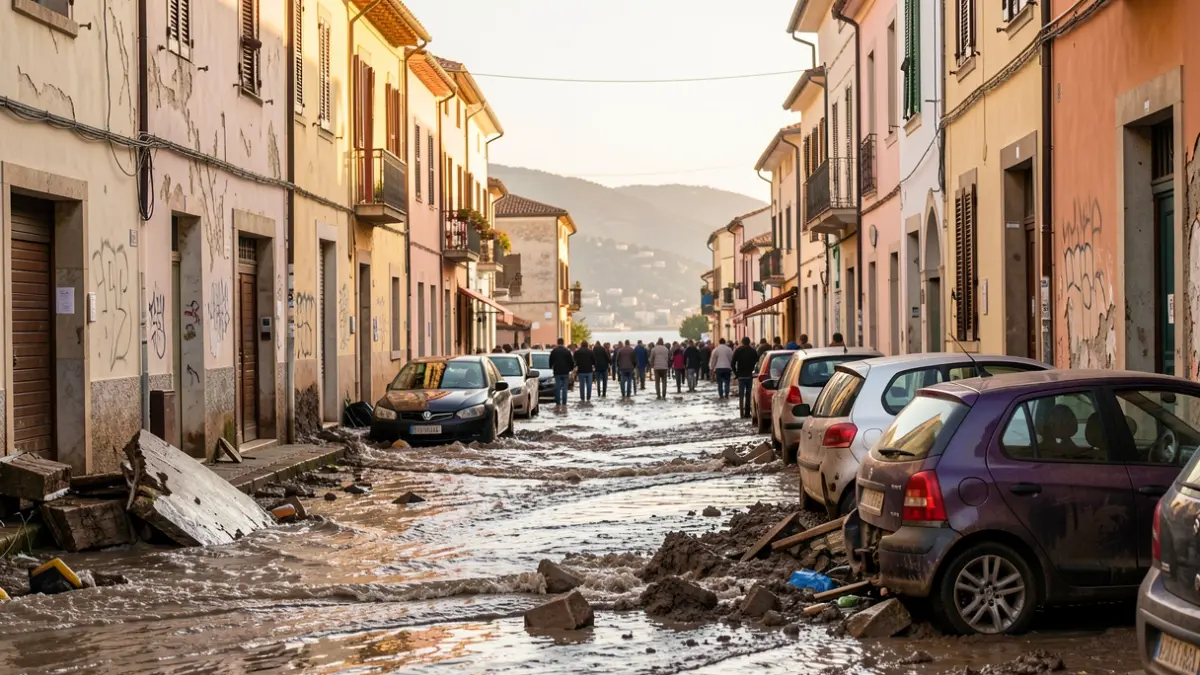
Recent torrential rains in the Tarragonès and Baix Penedès regions have highlighted the coast's vulnerability to extreme downpours, reigniting debate on managing consequences, particularly water evacuation. The mayors of Roda de Berà and El Vendrell, severely affected municipalities, have demanded structural actions, identifying the railway line and the N-340 as potential impediments to water flow towards the sea.
El Vendrell's mayor, Kenneth Martínez, emphasized the need for "bold decisions" to tackle what he termed a "structural" problem. He believes both the railway line and the N-340 act as barriers, hindering water flow in certain areas and causing accumulations that can circulate "like a siphon." Martínez proposed treating the issue as a "national matter," exploring the construction of more underpasses and expanding reservoirs and drainage systems to boost water absorption and evacuation capacity.
Pere Virgili, mayor of Roda de Berà, shares this assessment and urged Adif to act "forcefully" to make the railway infrastructure more permeable. Virgili noted that in the coastal neighborhoods, the challenge often lies in enabling accumulated water to reach the sea. This concern was previously communicated to Justice Minister Ramon Espadaler and will be raised again with the Government's sub-delegation to convey it to Adif and the central government.
Beyond road and rail infrastructure, mayors also aim to review the management of seasonal streams, especially those crossing multiple municipalities. Martínez pointed out the lack of a "good protocol" and consistent criteria for addressing these watercourses, advocating for "protocolizing" and "professionalizing" responses with shared guidelines. Despite damage primarily affecting vehicles, businesses, garages, and beach furniture, the seafront largely returned to normal by morning.
In Roda de Berà, assessments of damage to public roads, beaches, and the coastal area are ongoing. Virgili estimates around twenty vehicles were affected and anticipates beaches will take time to recover. A campsite in a flood-prone zone might require a "reconfiguration," despite previous efforts with the Catalan Water Agency (ACA).
In Coma-ruga, flood effects were still visible on Sunday. Staff removed mud marks from ground-floor windows at the Maramar hotel while guests dealt with insurers and tow services for damaged vehicles. Some tourists cut their holidays short, while others, like Elena Pérez from Zaragoza, chose to stay despite their car being unusable, emphasizing that "we are okay."
The absence of the ES-Alert during the event also sparked debate. Justice Minister Ramon Espadaler defended its non-activation due to a Meteocat alert level of 4 out of 6, deemed insufficient justification. Meteocat director Sarai Sarroca supported Civil Protection's actions, recalling issued prediction and surveillance warnings. Both Martínez and Virgili agreed on the need to explain these reasons to the public.