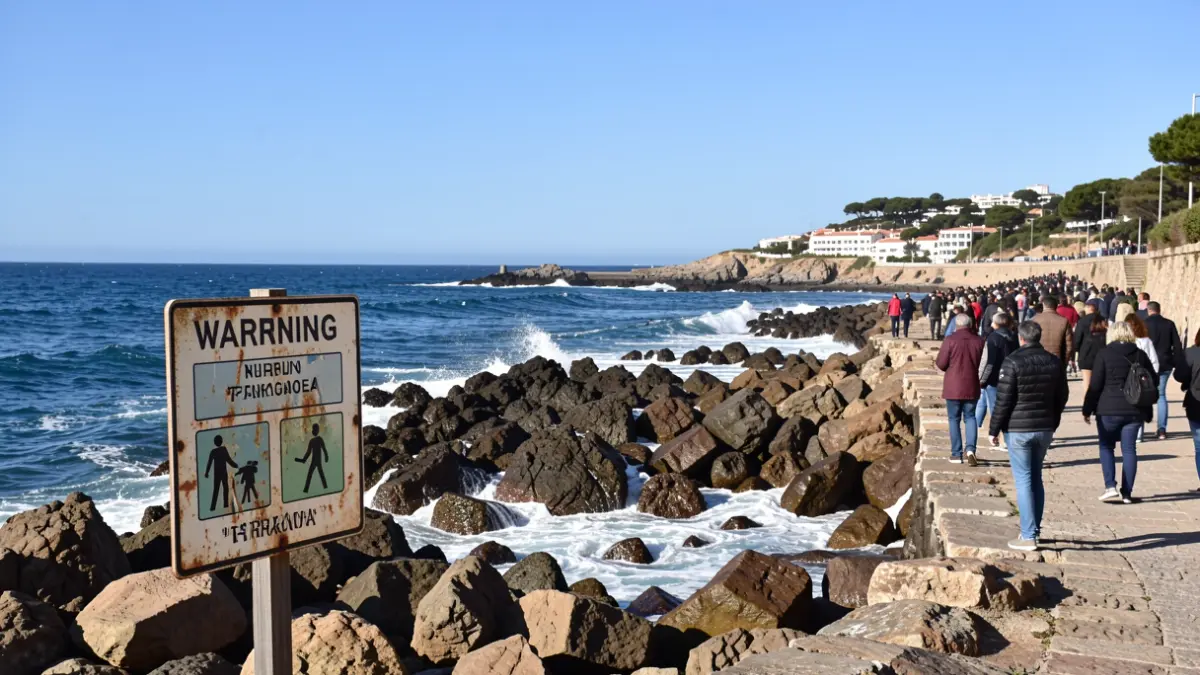
The Beach Surveillance Unit of the Local Police (UVIP) in Tarragona recorded 65 interventions and 20 fines last year related to people jumping into the sea from rocks. These figures represent an increase compared to the previous year, with 45 interventions and 6 fines. In the first two weeks of the current season, 6 interventions and one fine have already been counted.
The UVIP operates exclusively during the summer, from June 15 to September 13, with defined hours and a team of eight officers supported by other units. However, the official fine figures are just a small sample of a persistent problem that causes fatalities and injuries every summer along the coast of Tarragona and its province.
The Local Police will soon incorporate a drone to monitor these risk zones, a measure accelerated by the tragic accident on June 19 where three children died. The deputy chief of the Local Police, Alberto Lacueva Lacueva, has admitted that the city faces a significant problem, as young people, primarily, ignore lifeguards' instructions. The current penalty, classified as a 'minor offense,' is only 100 euros.
Ramsés Martí Biosca, an emergency nurse and lifesaving professor, points out that current measures are insufficient. He proposes revising outdated signage, applying 'social engineering' with the collaboration of psychologists and sociologists, and bringing awareness to schools, addressing tragic news like the deaths at La Arrabassada.
Martí also criticizes the potential complacency of municipalities in organizing rescues, recalling key rules: a lifeguard must be able to visually scan their area in 10 seconds and reach the furthest point within three minutes. The lack of a unified national or regional regulation turns aquatic safety into a 'patchwork'.
Regarding drones, Martí is skeptical, arguing that surveillance must be constant or access should be denied. He emphasizes that their usefulness depends on whether the operator is a water rescue expert capable of identifying victims in aquatic stress, and that their effectiveness is limited, especially if they cannot deploy flotation devices.
The expert also warns about the invisible dangers of jumping, such as shoulder dislocations from jumping with arms open or thermodifferential shock from sudden temperature changes after exercise. In rocky areas, complex currents and turbulence make rescues difficult, potentially requiring boats and delaying assistance.