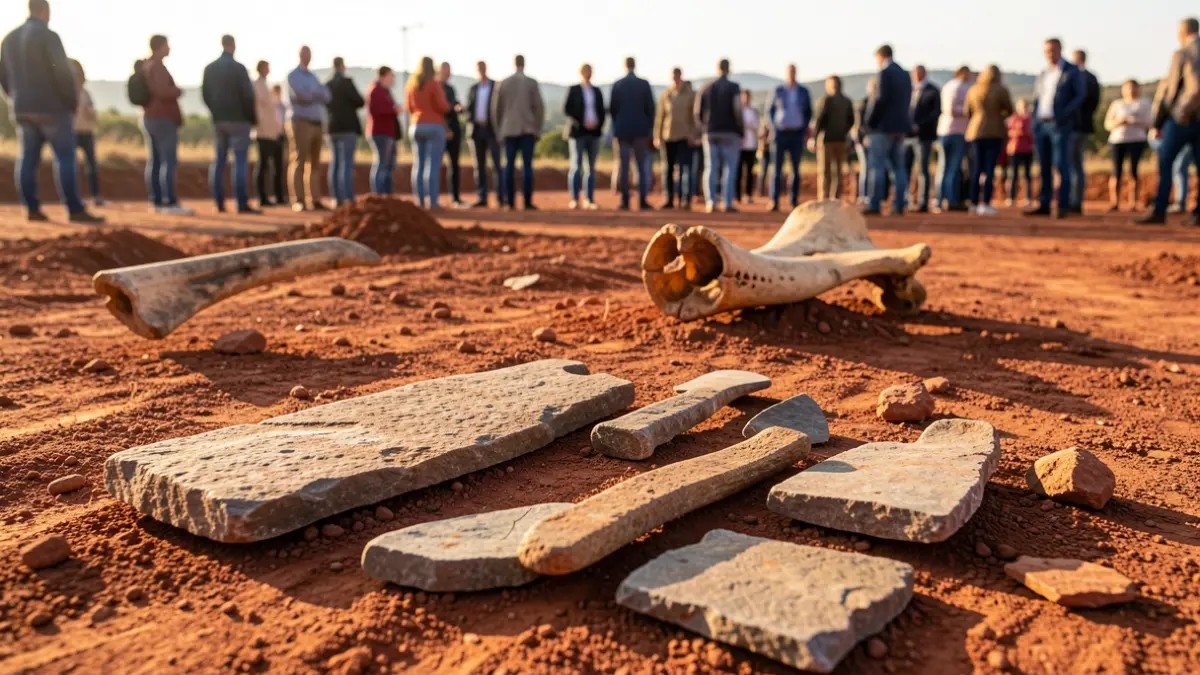
During September, a team of 50 people participated in excavation work at the Barranc de la Boella site, directed by Palmira Saladié and Josep Vallverdú, researchers from IPHES-CERCA. This twentieth consecutive campaign has expanded the collection of Acheulean stone tools and recovered new remains of large mammals.
Excavations focused on the Mina and Cala 1 locations. At Cala 1, a significant find was a rhinoceros scapula, discovered alongside two large worked flint pieces. This association is crucial for reconstructing the activities of human groups inhabiting the area nearly a million years ago.
Other worked stones were also recovered, including a quartzitic schist cobble with numerous percussion marks. These findings contribute to the study of early human dispersals from Africa into Eurasia and the arrival of Acheulean technology on the continent.
The Barranc de la Boella site preserves an exceptional record of large mammals from the Lower Pleistocene. A recent study in the journal Historical Biology analyzes mammoth remains, attributing them to an advanced form of Mammuthus meridionalis, and characterizes a Mediterranean environment rich in herbaceous plants.
This taphonomic study suggests that both human groups and hyenas accessed the proboscidean carcasses. The site's significance has been recognized by the journal, which features defenses and molars of a mammoth discovered at the site on its cover.
This year's campaign combined scientific research with practical training for undergraduate and master's students, including participants from the interuniversity master's program in Quaternary Archaeology and Human Evolution (Erasmus Mundus). The research is supported by IPHES-CERCA and the National Museum of Natural Sciences (MNCN-CSIC).
The archaeological intervention is part of the four-year project “Evolution of the paleoenvironment and prehistoric settlement in the Tarragona region,” funded by the Department of Culture of the Generalitat de Catalunya and the Town Council of La Canonja.