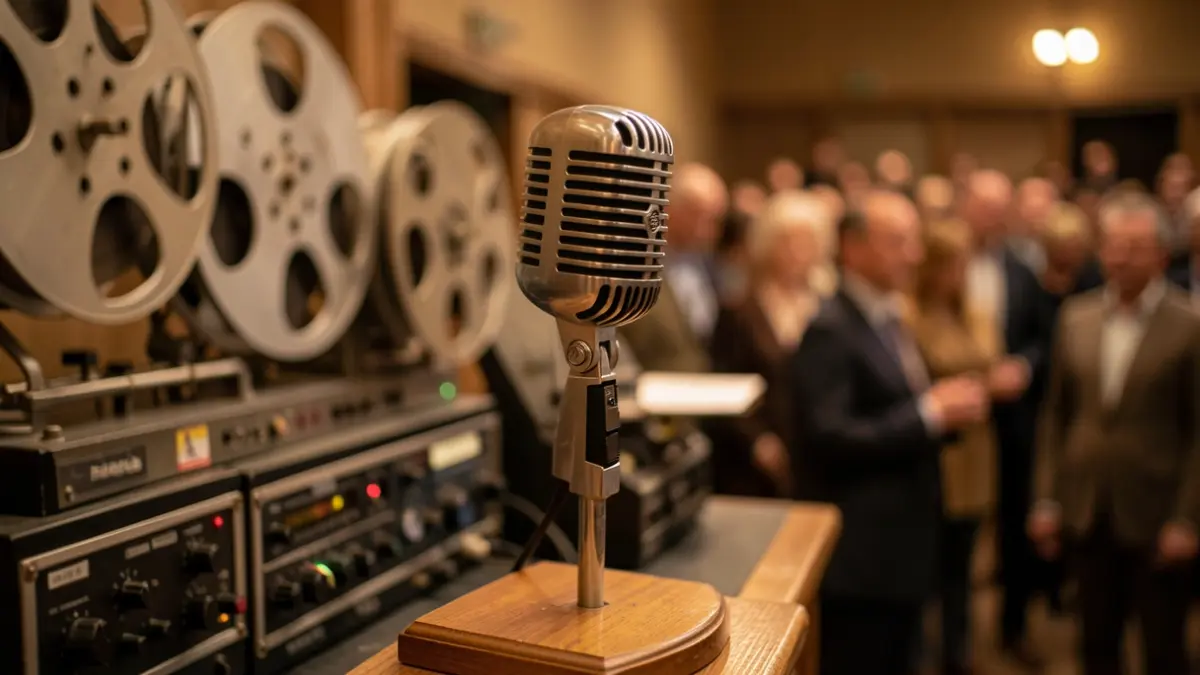
The festival aims to highlight the importance of sound as an essential element of audiovisual language and to value the work of the professionals involved. The FIC-CAT will dedicate the thematic focus of its 19th edition to cinematic sound, a crucial element of audiovisual language that, often without our conscious awareness, determines how we perceive a scene, interpret character emotions, and immerse ourselves in a story.
In 2027, it will be one hundred years since the premiere of The Jazz Singer, a film that marked a turning point in cinema history and opened the door to a new way of storytelling: with voice, music, and sounds integrated into the image. Released on October 6th, 1927, directed by Alan Crosland and starring Al Jolson, it became a milestone in the commercial integration of synchronized sound in cinema. Until then, screenings could be accompanied by live music and other sound effects, but new technologies allowed for the integration of recorded voices and sounds into the cinematic experience. Its success accelerated the transformation of the film industry.
A century later, sound is much more than a complement to the image: it is a narrative and expressive tool that builds atmospheres, defines characters, creates anticipation, suggests what we cannot see, and intensifies emotions. The tension of silence; a distant noise that foreshadows danger; a melody that evokes a memory or completely transforms the meaning of a scene. Sound also adds depth and realism to spaces, situates us in a specific time and place, and allows us to imagine what happens beyond the screen's limits.
A film's soundtrack, encompassing the combination of music, dialogue, and sound effects, is the result of creative and technical work that begins during filming and continues through post-production. Professionals from various specializations record, create, select, edit, and combine sound elements to build an experience consistent with the images and the director's intentions.
Part of the sound is captured directly during filming. This is the direct sound, primarily including dialogue and actors' voices, but also ambient sounds and other elements produced in the recording space. The sound team's job is to capture these voices and sounds with the highest possible quality, considering the acoustic conditions of each location and the production's needs.
However, not everything we hear in a film is recorded during shooting. In post-production, voices can be cleaned and edited, recording problems corrected, or dialogue re-recorded in a studio using post-synchronization techniques. Sound effects are also incorporated to reproduce or amplify actions, movements, and phenomena of all kinds. Some are retrieved from sound libraries; others are created specifically for the film.
In this process, foley plays a particularly interesting role: it involves recreating everyday sounds in the studio, such as footsteps, a closing door, or an object falling to the floor. These are details that contribute to making the action believable and, although often unnoticed, are fundamental to adding texture and realism to scenes.
Soundscapes, such as wind, rain, traffic, the murmur of a crowd, or birdsong, are added to these elements; they help define the space and context of the story. Music is also incorporated, providing another expressive dimension: it can accompany emotions, reinforce them, contradict them, or become a narrative element in itself.
Finally, in sound editing and mixing, all these components are organized, adjusted, and combined to achieve the desired balance between dialogue, ambient sounds, effects, and music. This is where the intensities, silences, transitions, and sonic perspective of each scene are defined, shaping a soundtrack that constantly dialogues with the image.
With this thematic focus, the FIC-CAT aims to highlight the work of sound professionals and explore the multiple expressive possibilities of one of the great pillars of cinematic language. It's an opportunity to discover the crafts behind each soundtrack, understand how a film's soundscape is built, and advocate for the importance of everything we hear when we watch cinema.
The 19th FIC-CAT will be held from June 4th to 12th, 2027, in Roda de Berà, and registrations for the festival's categories (feature film, documentary, short film, music video, and educational centers) are now open.