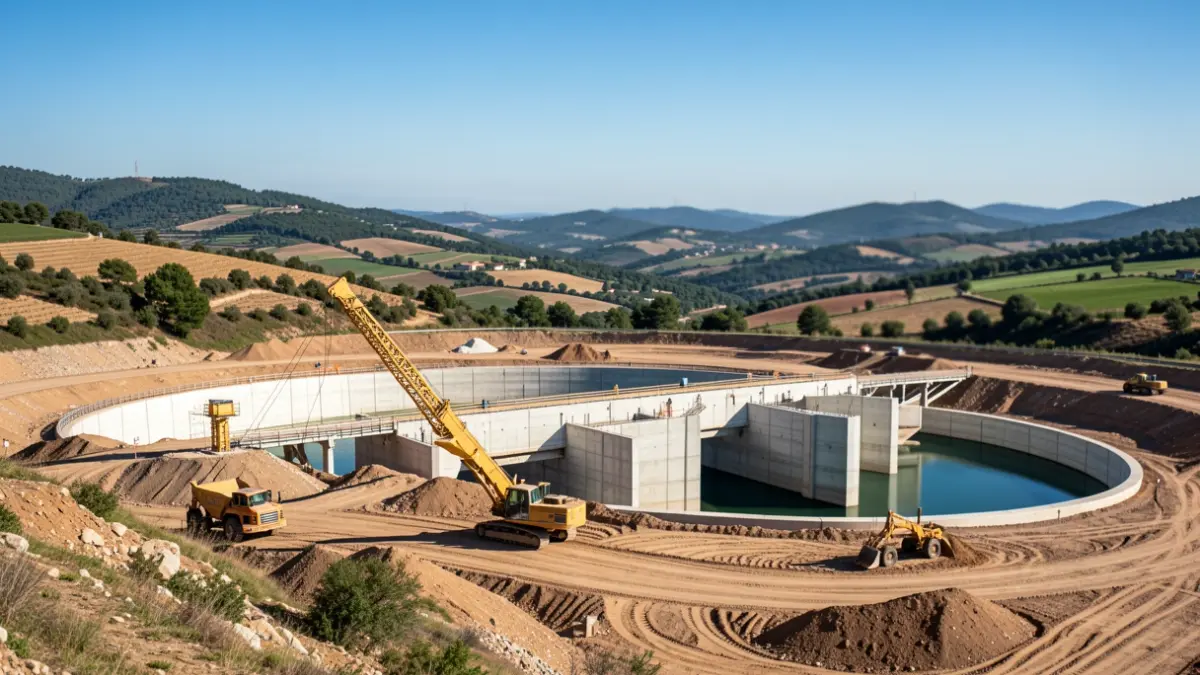
According to Pere Bailón, Head of Modernization for the Urgell Canal Irrigators, once the construction is finished, the filling plan will commence. Subsequently, administrative procedures with the Catalan Water Agency (ACA) will be carried out to make them operational for the upcoming irrigation season.
These infrastructures are designed to supply irrigation sectors once the Urgell Canal is fully modernized. In the meantime, the new reservoirs will help improve the existing system's hydraulic efficiency. The works have also included the lining of several kilometers of the canal, which have now been completed.
The Castellserà reservoir is the largest, with a capacity of 450,000 cubic meters, followed by Juneda with 350,000 cubic meters, and Penelles with 130,000 cubic meters. While the Urgell and Noguera infrastructures are nearly finished, awaiting improvements to access roads and fencing, efforts are now focused on the Garrigues reservoir, where the waterproofing membrane still needs to be installed.
The filling plan, scheduled before September and lasting approximately one month, is the next step to ensure the structures' safety. Once completed, procedures with the ACA for dam classification, safety, and self-protection plans can begin, aiming for all three reservoirs to be operational next season.
The reservoirs are part of the overall modernization project for the Urgell Canal. Their ultimate purpose will be to supply modernized irrigation sectors. As Bailón explained, each reservoir will have two sections: a reserve for potential canal breaks and another to manage discrepancies between water inflow and outflow.
Currently, with the canal still unmodernized, the reservoirs will serve to enhance hydraulic efficiency. They are strategically located next to main hydraulic conduits, allowing excess water to be stored and returned when needed, thus preventing loss.
These three are the first of the 44 reservoirs planned within the modernization project. Their construction was prioritized due to their strategic location, as they will be functional even before the entire canal modernization is complete, serving to store water when the channel has a surplus and supply it when it is dry.