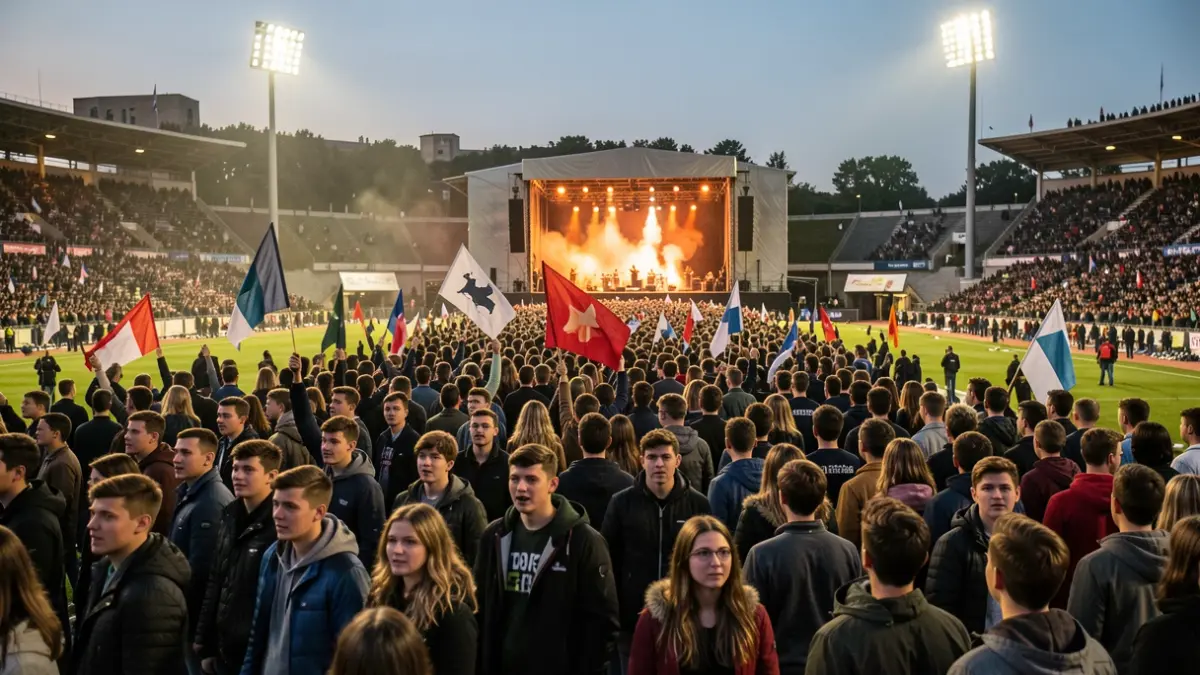
On June 20, 1976, the Nova Creu Alta Municipal Stadium was the epicenter of the Festival of the Peoples of Spain, an event that gathered between 15,000 and 20,000 attendees, mostly young people from the Barcelona metropolitan area. According to Joan Moles, one of the organizers and then president of the Federation of Neighborhood Associations of Sabadell (FAVS), it was one of the most significant civic, cultural, and political acts under the Franco dictatorship.
The festival's organization originated from the Joventut Comunista de Catalunya (JCC), linked to the PSUC, amidst a context of strong opposition mobilization. Four months prior, in February 1976, a General Political Strike had forced the resignation of Sabadell's Falangist mayor. The initiative for the festival began to take shape in April 1976 with the creation of a coordinator for youth groups.
To obtain permits from the Francoist authorities, the Coordinadora de Centres Culturals (Coordinator of Cultural Centers) and the FAVS acted as organizers, presenting the event as the closing of the 'Month of Youth'. These cultural centers had been promoted during the 1960s with the support of the Asociación Catòlica de Dirigentes (Catholic Association of Leaders), chaired by Antoni Forrellad.
Quim Góngora, also an organizer and JCC militant, recounted the tense meeting at City Hall to request permits from the Falangist deputy mayor, Juan Bernabeu González. Restrictive conditions were imposed, such as prohibiting stepping on the grass or requiring a permit from the Ministry of Defense for the spectacle's balloons, citing potential interference with the nearby airfield.
The day before the festival, Joan Moles was summoned to the Armed Police station. There, representatives of the uniformed police and the Political-Social Brigade informed him of warnings and prohibitions: the display of unauthorized flags had to be prevented, shouts against the regime avoided, subversive propaganda not distributed, and attendees were to disperse peacefully.
Despite the restrictions, on the festival day, thousands of young people attended, many displaying prohibited flags and chanting anti-Francoist slogans. Artists such as José Antonio Labordeta, Miró Casabella, Al Tall, Enrique Morente, UC, Elisa Serna, and Oskorri performed. Songs like 'Canto a la libertad' or 'L'estaca' resonated strongly.
During the event, a minute of silence was observed for those who died fighting for freedom. Leaflets were distributed, 'La Internacional' was sung, and flags like the ikurriña and senyera waved. Before the final performance by Lluís Llach, speeches were made about the Congress of Catalan Culture and support for the Sahrawi people.
At the festival's conclusion, a group of about 300 people marched in demonstration towards Marcet square, dispersing in the face of police presence. Joan Moles described a notable presence of young people with folded flags and a generally animated atmosphere, despite police surveillance.
The following day, Moles was interrogated at the police station by the civil governor, who was displeased with the event. He was questioned about details such as the flags displayed, the speeches, propaganda distribution, and the organization of the subsequent demonstration.
The captain of the armed police commented to Moles that, had he received the order, he could have cleared the stadium. Moles argued that the event had proceeded without serious incidents and represented a display of civility, in line with the government's announced democratic normalization.
Despite the public success, the festival incurred a "huge deficit" due to massive ticket counterfeiting, which prevented the payment of artists' fees. The PSUC executive had to cover the debt, with some artists waiving their fees or receiving payments from individuals.
Following the festival, the coordination of youth sectors was formalized under the name Gestora del I Congrés de la Joventut Catalana, as recounted by Jordi Serrano.