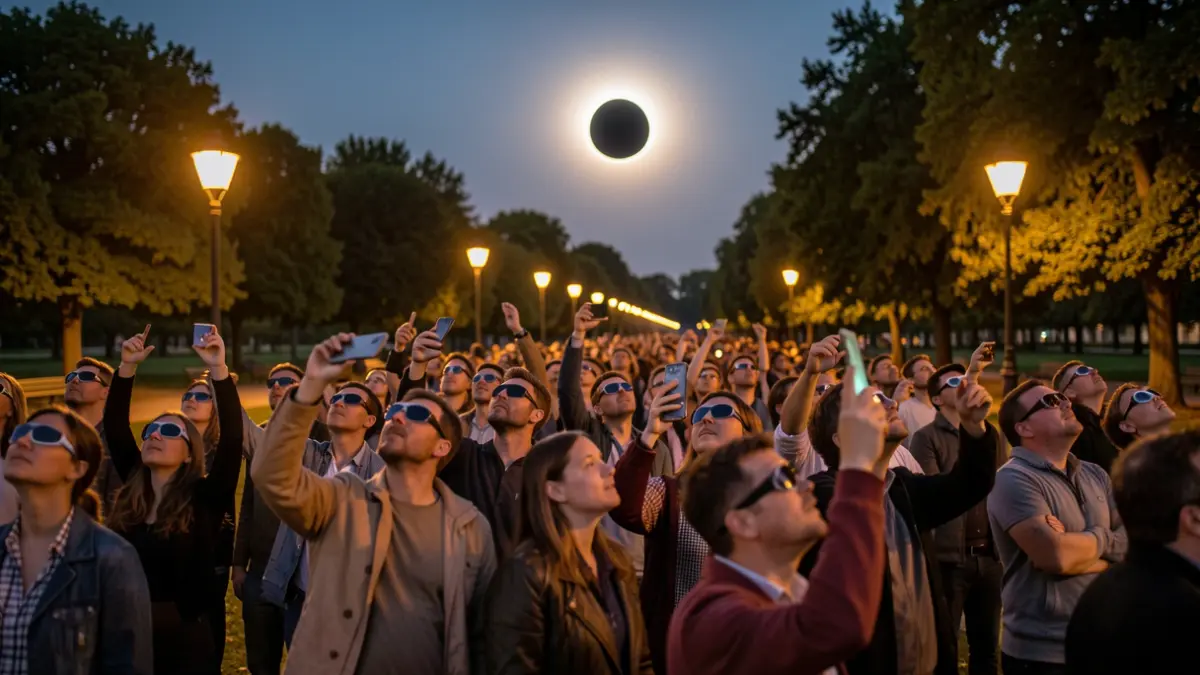
The city of Sabadell experienced an astronomical day yesterday as thousands of citizens watched the solar eclipse from various locations. Parc de Catalunya was the epicenter of the gathering, drawing a crowd that exceeded expectations, estimated between 3,000 and 4,000 people. Although the eclipse was not total in the city, reaching 99.5% coverage, the phenomenon left attendees in awe, prompting applause at the peak moment.
The Astronòmica association provided telescopes for the public and sold special glasses, leading to initial queues. However, most attendees watched the event from the ground, equipped with glasses and phones. Around 8:45 PM, near-totality was reached, with the appearance of the so-called 'Baily's beads,' a phenomenon occurring when the moon almost completely covers the sun, allowing light to pass through lunar craters. These moments were met with applause.
The viewing was massive yet peaceful. Several curiosities were observed, such as projecting the eclipse onto a cardboard for those without glasses. The logistics of taking photos with mobile phones while wearing solar protection proved a minor challenge for some. Many took advantage of the outing to the park for picnics and dinner, and began to depart as the phenomenon waned around 9 PM.
For those wishing to relive the event, Astronòmica has uploaded the broadcast to its YouTube channel. The association also sent a delegation to Burgos to observe the eclipse with NASA. This type of total solar eclipse will not be seen again in Catalonia for 150 years. However, a more spectacular total solar eclipse is expected on August 2, 2027, in southern Andalusia and North Africa. In 2028, on January 26, an annular eclipse is predicted for Catalonia.