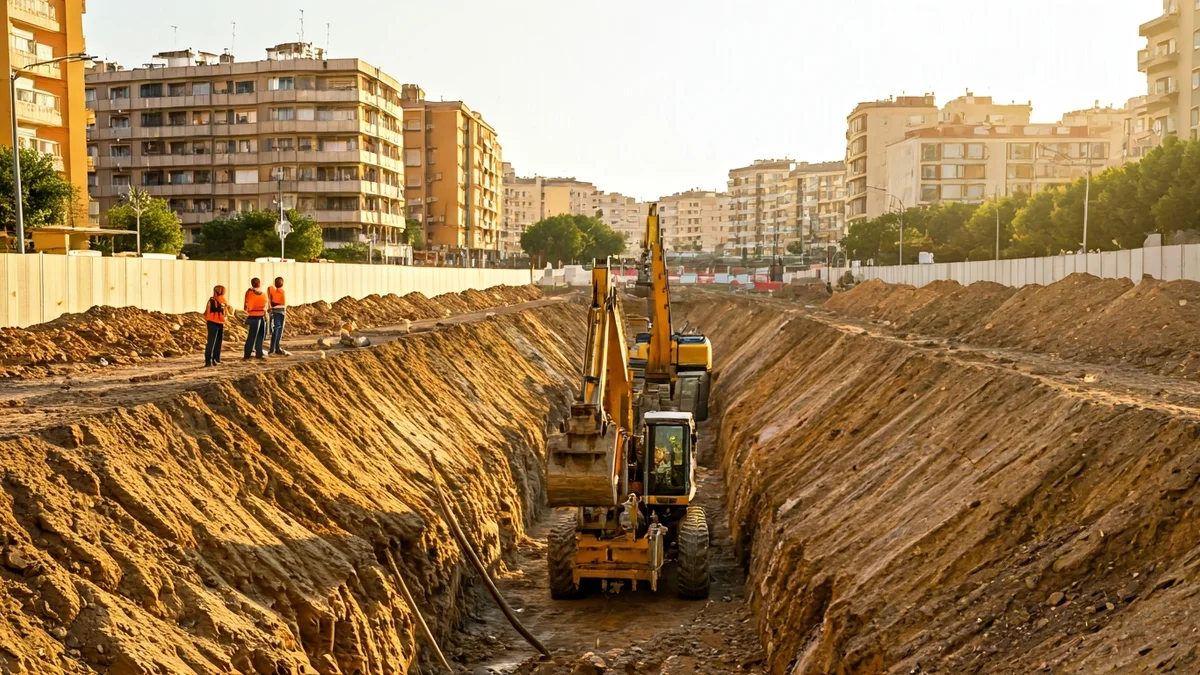
The large-scale project to place the R2 railway lines underground as they pass through Montcada i Reixac, initially planned for a total of seven years, has reached its second anniversary with favorable progress. Mayor Bartolomé Egea highlighted that the works are advancing according to the established schedule, despite a 'scare' in early 2025 when cracks appeared in three buildings in Can Sant Joan, necessitating a temporary halt to implement new drilling and deepening techniques.
However, coexisting with the construction is not easy for residents. Mobility in the municipality, already complex due to the presence of railway lines, highways, and rivers, has been exacerbated by street closures, noise, dust, and the movement of large trucks in the area. Egea expressed his concern about the difficulties in getting around, parking problems, and the negative impact of the project on local businesses and educational centers near the work zones.
In parallel, significant improvements are being planned for the train stations. The Terra Nostra station has already been renovated and is accessible. At Montcada-Bifurcació, in Can Sant Joan, the first phase has been completed with the new track layout, and the construction of a new building has been awarded for seven million euros. Works at the Montcada-Ripollet (R3) station are already underway, while the remodeling of Montcada-Manresa is in the study phase due to its complex accessibility. The Montcada Centre station, on the R2 line, will be underground and 'very modern'.
“"It makes no sense that a highway running through the entire city has neither an entrance nor an exit. For industrial reasons, given the industrial estates we have, it would be very important to do so to divert traffic. We have requested it from the minister, and it is under study."
In terms of road infrastructure, the Montcada i Reixac City Council has requested the installation of acoustic screens and the creation of a new interchange on the C-33. The Minister of Territory, Sílvia Paneque, announced in February that the Generalitat and the council are working on preliminary studies for the interchange. The opposition leader and spokesperson for En Comú Podem, Laura Campos, emphasized the urgency of the screens, stating that the noise from the C-33 is 'daily torture' for adjacent neighborhoods, especially since the abolition of AP-7 tolls.
Regarding social services, the local government (formed by PSC, Vivim, and PP) has initiated procedures to build a care home and day center with 120 residential places, 30 day center places, and 36 subsidized housing units. The tender for construction and operation was approved in late 2025. The Councilor for Social Services, Estela Valdivia, defended the project as a 'necessity' given that 16% of the population is over 65. The opposition, represented by ERC and Comuns, has expressed doubts about the feasibility of securing public places from the Generalitat, although Valdivia has assured the commitment of the Minister of Social Rights to guarantee public places.
“"We could end up with a 100% private center because no one can assure us that the Generalitat will eventually subsidize places in the future service."
Another recent initiative is the creation of a sixth nursery school in the Mas Duran neighborhood, a proposal that has received unanimous support from all political forces. Finally, the 2026 budget was approved solely with the votes of the governing team, who consider it 'legal, responsible, prudent, realistic, and deeply social'. The opposition, however, criticized the 'lack of rigor' and 'fragility' of the accounts, which depend on volatile revenues and do not present a 'clear city project in the medium and long term'.