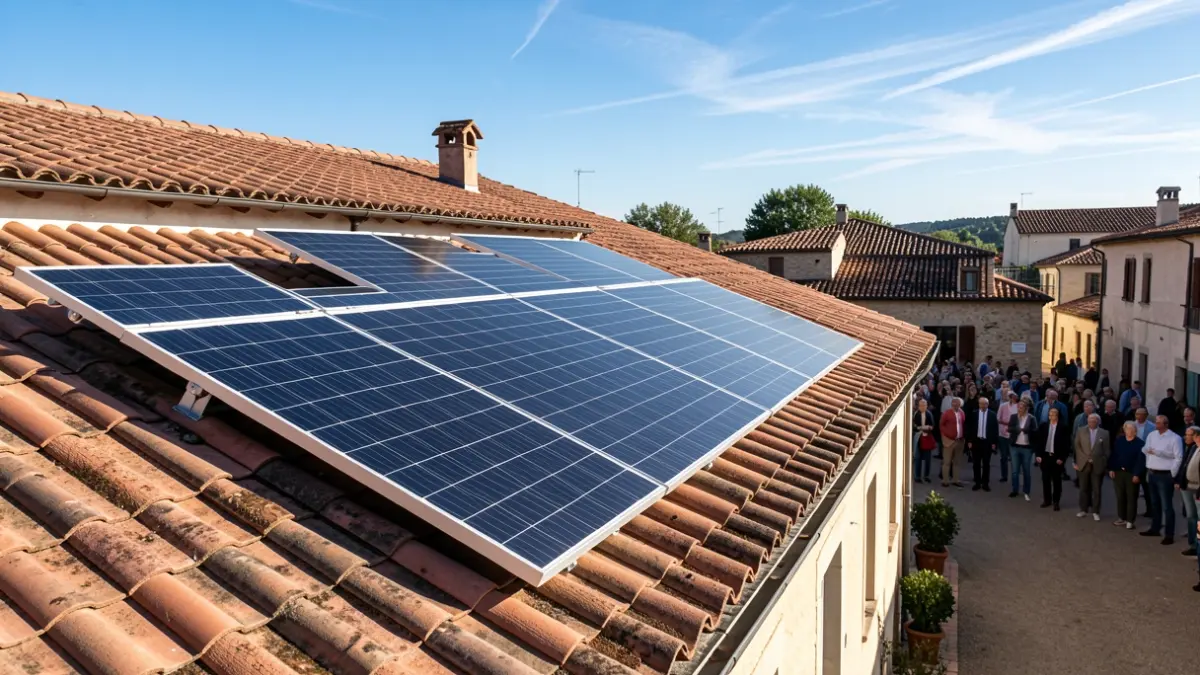
The Generalitat's public energy company, L’Energètica, has finished installing six photovoltaic facilities in educational centers in Sabadell and has two more installations in the project drafting phase. Furthermore, in the coming months, the feasibility of eight additional centers for solar panel placement will be assessed.
This initiative is part of a broader campaign by L’Energètica, which aims to implement 234 more photovoltaic installations in educational centers across Catalonia, adding to the 107 already completed. The goal is to ensure that by 2028, all technically viable institute rooftops are equipped with these systems. The metropolitan area of Barcelona will see 177 of these installations in the coming years.
In Sabadell, the institutes Pau Vila, Agustí Serra i Fontanet, Can Rull, Joan Oliver, and the Institut Miquel Crusafont i Pairó, as well as the Official School of Languages, already have solar panels. The Institut Escola Industrial and the Llar d'Infants Els Àngels will also be equipped soon.
L’Energètica also plans to analyze other rooftops of educational centers in the city to determine their suitability for photovoltaic installations. Feasibility depends on factors such as the roof's condition, solar exposure, and structural capacity to support the panels' weight. Roofs requiring prior renovation, excessive shading, or structural reinforcement might prevent installation.
According to L’Energètica sources, the installations operate under a collective self-consumption system. The generated energy is primarily used by the center itself, with any surplus distributed to other facilities within a five-kilometer radius. This allows energy not consumed, for instance, during school hours, to be utilized by Primary Care Centers, police stations, or judicial facilities.