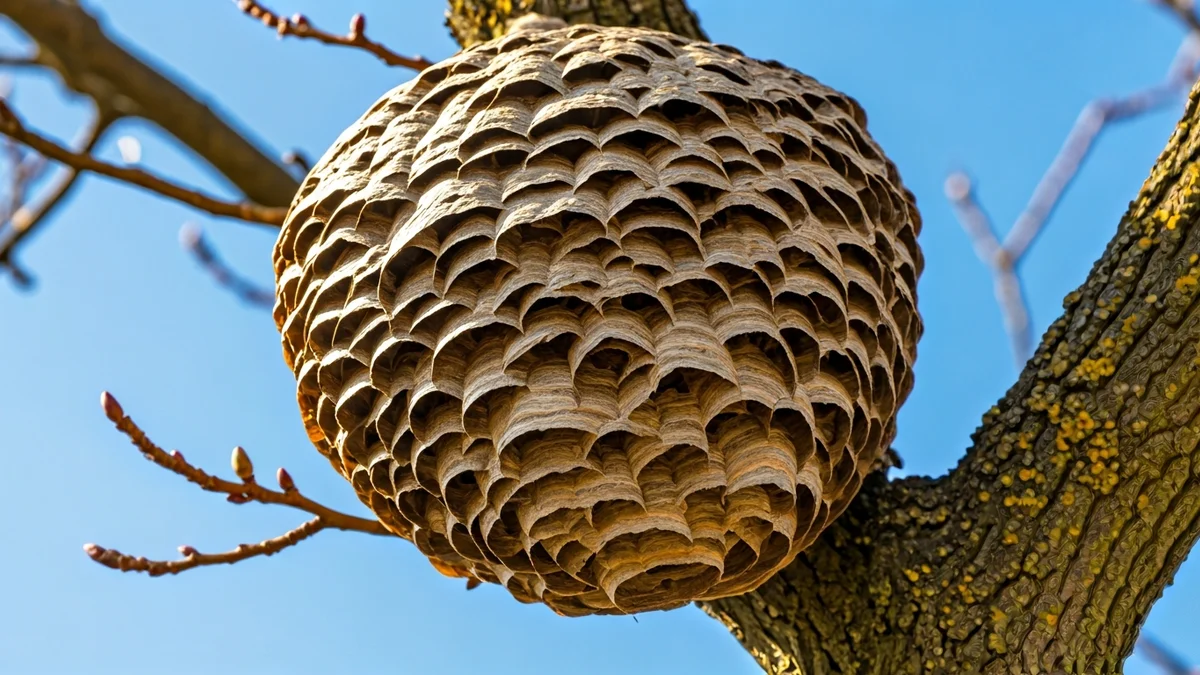
The presence of pollinating insects in Terrassa becomes more evident with warmer weather. While the city hosts dozens of bee and wasp species, the Asian hornet (Vespa velutina) has become a growing concern. Last year, 23 operations were recorded to control this invasive species, which is now fully adapted to the local environment.
According to estimates based on studies by the Universitat Autònoma de Barcelona, there are between 50 and 100 different bee species in the city's surroundings. The honey bee, the most common, can form hives with up to 60,000 individuals, suggesting hundreds of thousands of specimens in Terrassa. In contrast, most wasps are native and solitary, with the exception of the Asian hornet, which causes conflicts with the environment and people.
“"At the beekeeping level, bees are their main food. When they find hives, they can end up exterminating them."
Rubén Alcaraz, from the Associació Molí del Fort, one of the companies involved in controlling this pest, emphasizes that the main impact of the Asian hornet is on biodiversity, especially in beekeeping. This threat extends to other wild pollinators, with potential consequences for plant and crop pollination. The Asian hornet is distinguished by its larger size, mostly black body, and yellow legs, and its secondary nests are large spherical structures, often high in trees.
Upon detection of a nest, a specific action protocol is activated, which may include the use of gases or teleinjections with biocides. The extermination of each colony is non-negotiable given its invasive nature and the danger it poses. An Asian hornet sting, although the venom is similar to that of native wasps, can be equivalent to four or five stings from the latter due to its size.
Municipal data from Terrassa show a constant increase in actions against the Asian hornet since its detection in 2017. From 12 nest removals in public spaces in 2022, the figure rose to 14 in 2023, 21 in 2024, and 23 in 2025. For prevention, the City Council uses drones to geolocate nests in high-incidence areas such as Vallparadís Park and the Palau and Arenes streams.
Regarding bees, the Environmental Service records an average of ten annual notices for swarms. The Bombers de la Generalitat perform about 80 similar services across Vallès Occidental, Oriental, and Maresme. Spring is the natural swarming period for bees, a reproductive process where the old queen leaves with a group to form a new colony. These swarms, though impressive, are usually not aggressive as they do not have a hive to defend.
“"Do not approach or try to manipulate them. The best thing to do is to call 112 so that the situation can be assessed and, if necessary, the area cordoned off."
In the presence of a bee swarm or wasp nest, experts advise against direct intervention and recommend calling 112. The Fire Department or specialized services remove bee swarms and transfer them to beekeepers for relocation, thus protecting a key species for ecosystems. Native wasps are only intervened if they pose a risk, while invasive ones, like the Asian hornet, are inactivated by specialized companies.