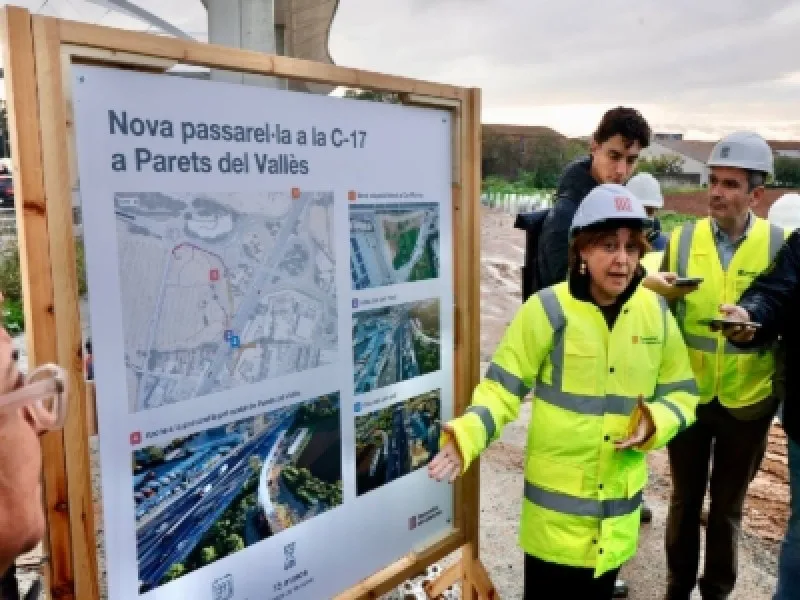
The Minister for Territory, Sílvia Paneque, has visited the works, which have reached an important milestone with the placement of the main deck of the structure. The works, which began a year ago, will be completed by the end of next February. The infrastructure will connect the urban centre of Parets del Vallès with the Can Volart industrial estate, improving active mobility and road safety for workers who currently have to cross the road on foot or by bicycle.
“"In infrastructure, the Government is adapting to all new types of mobility. Many infrastructures we are building at the moment have cycle lanes on the sides because there is this type of mobility. In addition, a road safety issue was added here."
The route has a total length of approximately 320 metres. It starts in the urban area, where a segregated pavement has been built next to the C-35 road. Upon reaching the junction with the C-17, the route turns south to gain sufficient height to cross the motorway. The main deck is formed by a tied-arch structure, with two metal arches and a lattice structure, with a length of 37 metres and a width of 3.5 metres. Its placement required a night-time closure of the C-17 carriageway.
Once past the motorway, next to the industrial estate, a ramp and stairs have been built to connect the deck to Can Gurri street, near the Can Volart farmhouse. The work also includes improvements to road access, such as lighting at the junction between the C-17 and C-35 roads to improve safety, and continuity of the south side carriageway at Can Romeu street in the direction of Barcelona. This action is part of the global improvement project for the C-17 in the Vallès Oriental.