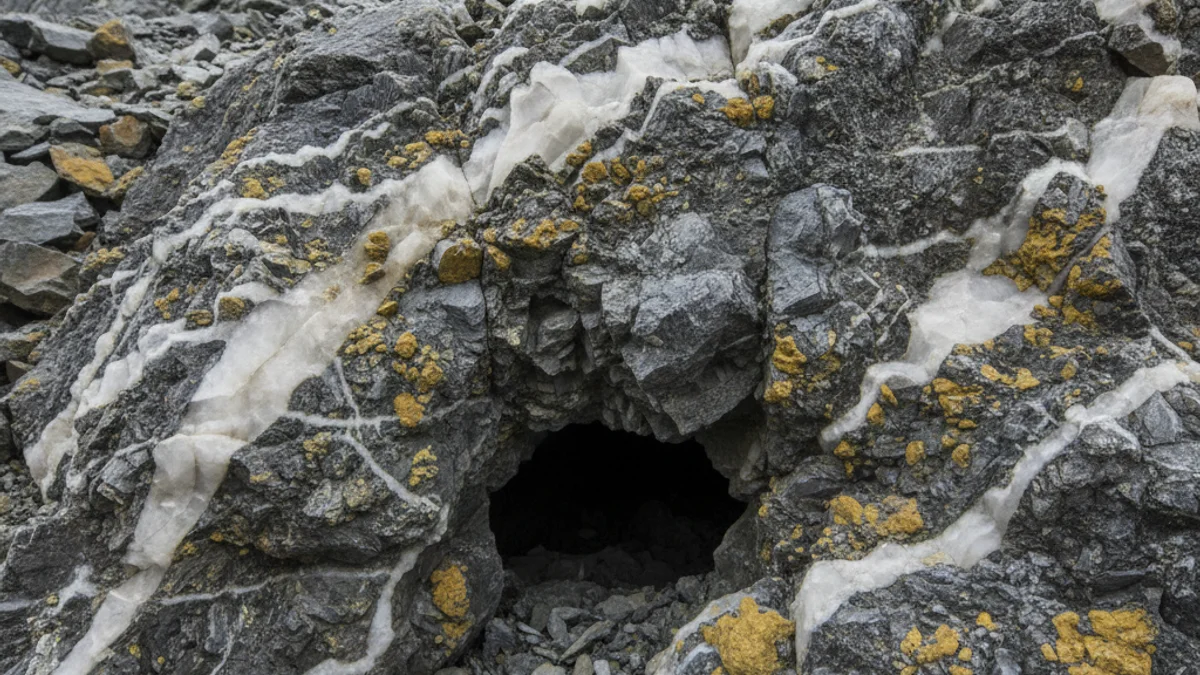
The mining operation, located in the area of Sant Pere del Pla de l’Arca, was carried out in quartz veins within crystalline rocks. Up to six access points to this deposit are known, which is even mentioned in the book La capella Embruixda by Joan Tocabens.
The mining fever in the early 20th century brought two Belgian investor brothers, the Gascar, to the La Jonquera border. They were looking for gold and arsenic (highly valuable for the chemical industry and metallurgy) in the Albera, an area already known to French geologists for its great mineral wealth.
“"Recently, while looking for bunkers, and knowing that when a tunnel is dug all the stone inside is thrown out, we saw a large amount of stone on top of the closed mine door. And we thought: 'Wow, maybe there's another opening.' We went up and found it."
The mining project operated until the outbreak of World War I (1914-1918), at which point the Gascar brothers were called to duty and never returned. Although the minerals were disseminated and extracted in small quantities, the activity ceased and the galleries fell into disuse.
The Albera is a geological massif with over 300 million years of history, formed by granites and schists. Deep fractures have allowed the circulation of metal-rich hot fluids, precipitating minerals such as arsenic, pyrite, and microscopic gold, often chemically associated with arsenopyrite.