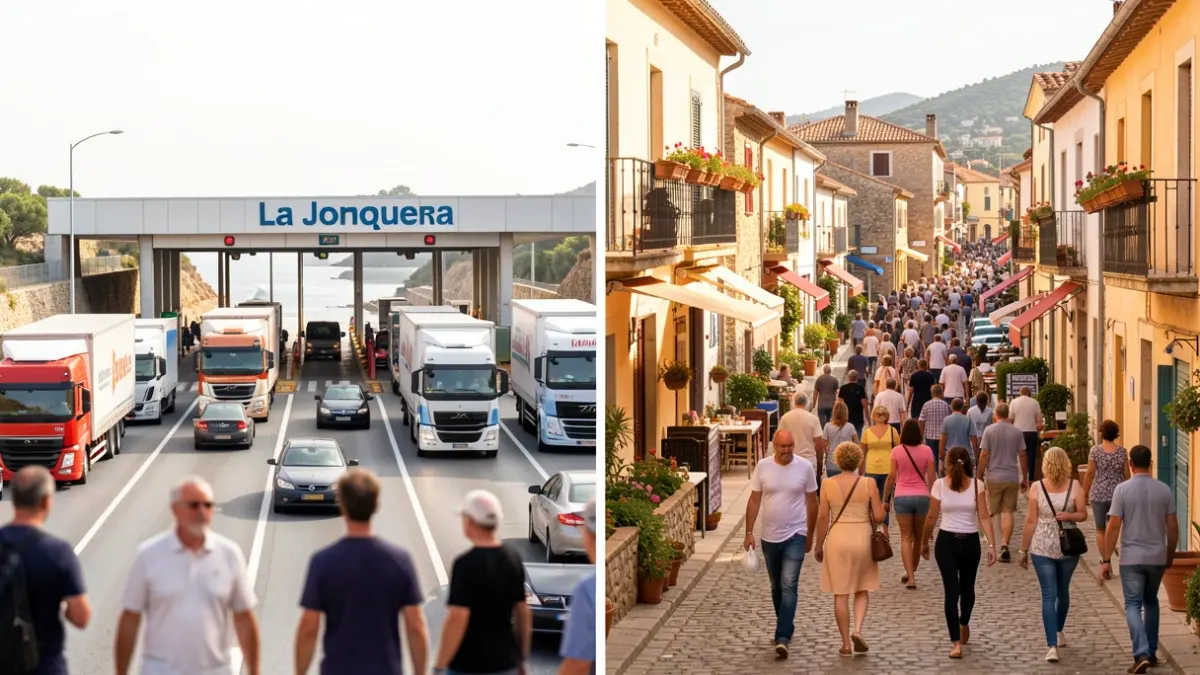
La Jonquera leads tourism pressure in Alt Empordà with a surprising figure: 1,519,912 overnight stays recorded in 2025, according to INE data. This volume, representing over 440 trips per inhabitant in a municipality of just over 3,400 residents, highlights a reality very different from the traditional tourism saturation associated with coastal towns like Cadaqués, which ranks eighth with 52.7 trips per inhabitant.
Unlike other municipalities where holiday tourism is the main driver, in La Jonquera, pressure is intrinsically linked to its status as a border town and a key point for international transport. The mayor, Míriam Lanero, points out that French regulations on heavy goods vehicle circulation during weekends and holidays cause many international transporters to stop in the municipality, often extending their stay or spending the night. This situation, she explains, "biases" the tourism pressure data, as it does not exclusively reflect holiday visitors.
The municipality handles approximately 10,000 trucks daily, a figure that underscores the need to provide services to a floating population far exceeding the resident one. Lanero highlights the additional investment required in street cleaning and security, with a local police force of 17 officers, to address the challenges of a border municipality. Public-private collaboration, especially in installing security cameras in truck parking lots, is considered key.
In contrast, Cadaqués faces more conventional tourism pressure, marked by visitor concentration during the summer months. The municipality swells from 2,800 residents in winter to around 30,000 people in high season. The City Council has commissioned a study to determine the town's maximum capacity and identify the most saturated areas, aiming to develop a strategic plan. Tourism Councilor Núria Duran describes the situation as a trend towards becoming "a theme park".
Other municipalities in Alt Empordà also show diverse dynamics. El Port de la Selva and Sant Pere Pescador register notable seasonal increases in small-sized municipalities. Roses, Castelló d’Empúries, and l’Escala, with a larger tourist and residential offering, accumulate hundreds of thousands of overnight stays. Figueres, on the other hand, shows a low proportion of overnight stays (6.5 per inhabitant), despite being a significant attraction hub, indicating that overnight data does not capture all the pressure from transit visitors.
Portbou presents a particular case, with an increase in tourist accommodation but a decrease in seasonal population, showing that increased supply does not always translate into more temporary resident visitors. These different scenarios underscore that tourism pressure in Empordà is multifaceted and cannot be explained by a single figure alone, requiring an analysis that considers the resident population, daily mobility, seasonal concentration, and the capacity of municipal services.