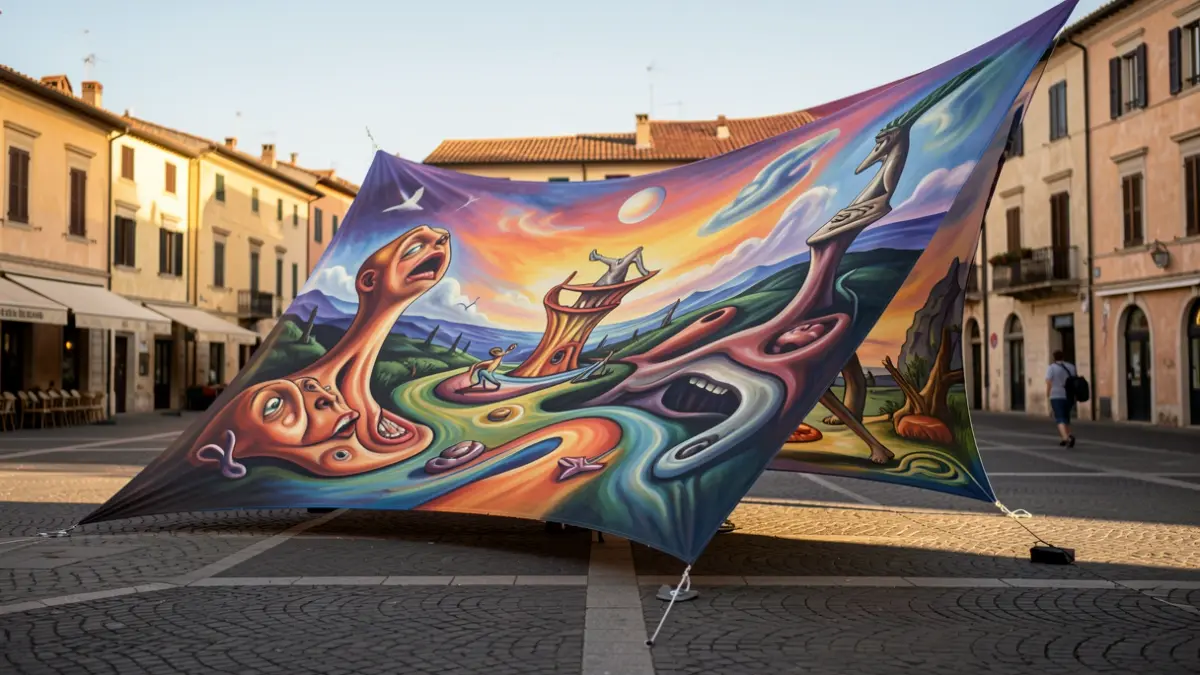
From Figueres, with large fabric structures inspired by Dalí's universe, to the Alps glacier with molds for inflatable igloos, Tecnodimension demonstrates its capacity to materialize complex projects. The company, based in Bescanó, operates in a hybrid sector combining technique and creativity, specializing in inflatable structures and textile architecture.
Officially founded in 2001 by Jesús Pallarès and four other partners, the company emerged from prior experience in the inflatable sector, then more focused on leisure. Today, under the leadership of the second generation, such as Sergi Pallarès, Tecnodimension has evolved towards more technical and urban applications, including climate shelters and contemporary art installations.
The company, requiring a workforce of twenty to twenty-five employees, has witnessed the inflatable sector transform from a purely leisure option to an essential tool in textile architecture. This shift responds to new climatic and urban needs, with a growing demand for adaptable structures for public spaces and events.
One of its most notable projects is the climate shelter on Besalú street in Figueres, a structure combining urban shade with high-resistance artistic printing, inspired by the work of Salvador Dalí. This project, initially a pilot test, has become a recognizable installation for the company in the Girona region.
Versatility is key for Tecnodimension, which tackles daily challenges by developing new solutions, adapting materials, and exploring unconventional structures. Its portfolio ranges from habitable bubbles and immersive projection igloos to collaborations with artists for ephemeral installations, such as 'La Trena' with artist Laia Estruch.
The company primarily operates in Spain but also has a presence in Europe, with projects in Germany, Italy, Portugal, and the Netherlands. A recent example is a large inflatable igloo for immersive audiovisual experiences in Dutch schools, and another in high mountain environments in the Alps, transforming the landscape into a sensory stage.
Asian competition prompted Tecnodimension to redefine itself about a decade ago, specializing in customization, engineering, and complete client adaptation, as they manufacture everything from scratch. This strategy allows them to occupy a unique niche among industry, art, and architecture, undertaking projects with the initial uncertain response: "We don't know if this can be done".