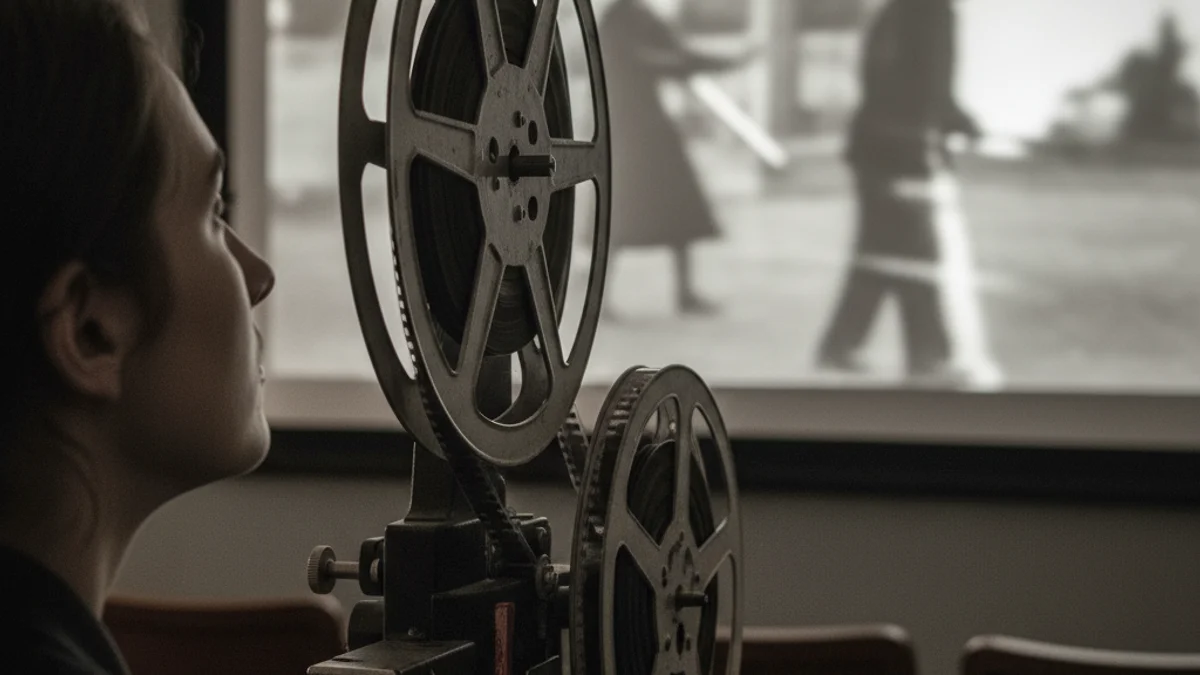
Resnais's career, born in Brittany, was shaped by his childhood as an avid reader, influenced by authors like Jules Verne and Alexandre Dumas. After studying at the Institut d'Hauts Études Cinématographiques, he focused on editing and documentaries. His most chilling documentary is Night and Fog (1955), which combined archive footage of the horrors of Mauthausen and Gusen concentration camps with text by poet Jean Cayrol.
Resnais is often mistakenly grouped with the 'Nouvelle Vague' (like Godard or Chabrol), but he belonged to the 'Rive Gauche'. While the former focused on American cinema, the 'Rive Gauche' read Positif, had political consciousness, and practiced introspection into memory, aligning with the 'nouveau roman' movement.
Hiroshima, mon amour (1959) was initially planned as a documentary about the atomic bomb dropped on Hiroshima and Nagasaki in August 1945, but it evolved into a unique fiction. The screenplay, by Marguerite Duras, maintains a continuous poetic breath. The plot centers on 24 hours of love between a French actress (a splendid Emmanuelle Riva) and a Japanese architect whose family died in the atomic disaster.
The film uses flashbacks as brief fragments of memory, a concept that the empiricist philosopher Locke defined as “the matter of consciousness.” Through creative editing, Resnais advances the narrative by alternating the present relationship in Hiroshima with the actress's painful memories in Nevers during the German occupation.