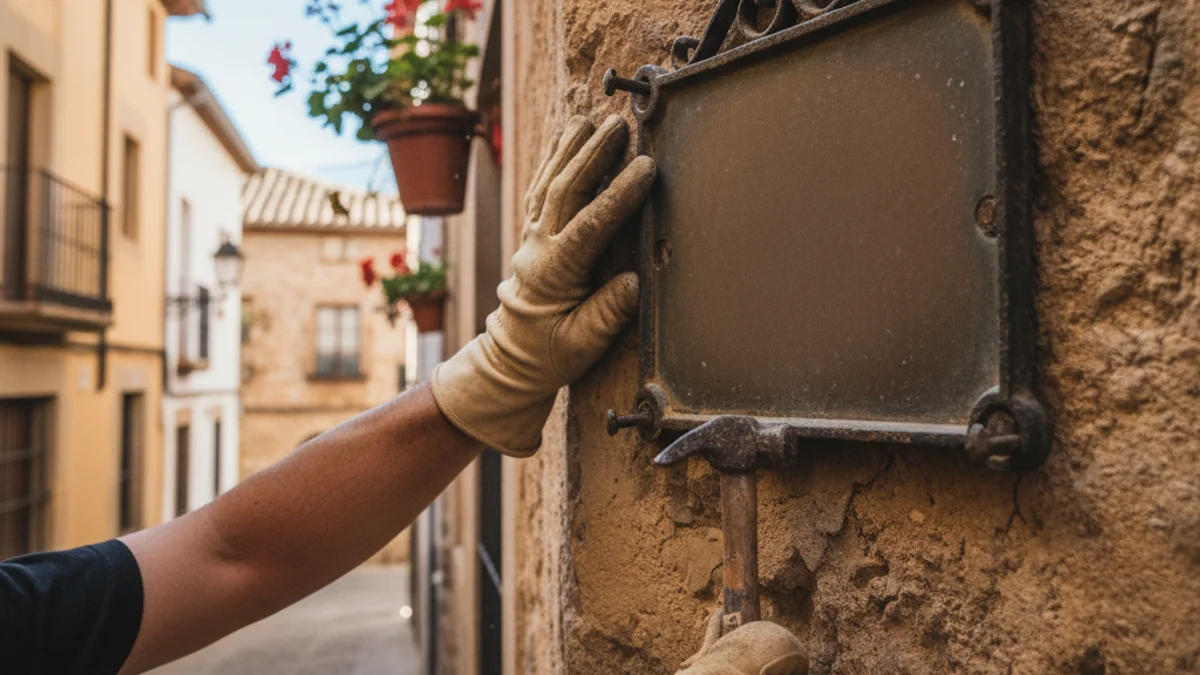
The renewal of the signage in the city center took place with the presence of grandchildren and great-grandchildren of Vilà, accompanied by the Mayor of Tortosa, Mar Lleixà, the First Deputy Mayor for Urban Planning, Jordi Jordan, and the Councilor for Services, Marga Abelló. The council explained that they wanted to explicitly state the title of doctor, as this is how many people still refer to him, as was common in the 1960s.
“"We have carried out the renewal of the plaques at the request of the descendants of Doctor Vilà, without this implying a change in the street's nomenclature, which remains the same."
In addition to the main sign, the sign at the intersection of the same street with the Avinguda de la Generalitat was also replaced, having disappeared about 15 years ago due to commercial construction work. The street was dedicated to Manuel Vilà in 1964, one year after his death.
Doctor Manuel Vilà Olesa was born in Tortosa in 1881. After graduating in medicine from the Faculty of Medicine of València in 1902, he directed the Tortosa Municipal Laboratory. In 1906, he took over his father's practice and the presidency of the Red Cross in Tortosa.
Vilà stood out especially as a researcher of malaria in the Ebro Delta and for the discovery of Infantile Kala-Azar, a disease that was the focus of his doctoral thesis, defended before a tribunal chaired by Santiago Ramón y Cajal. He was popularly known as “the doctor of the poor” for his charitable work, even leaving money under patients' pillows for medication.