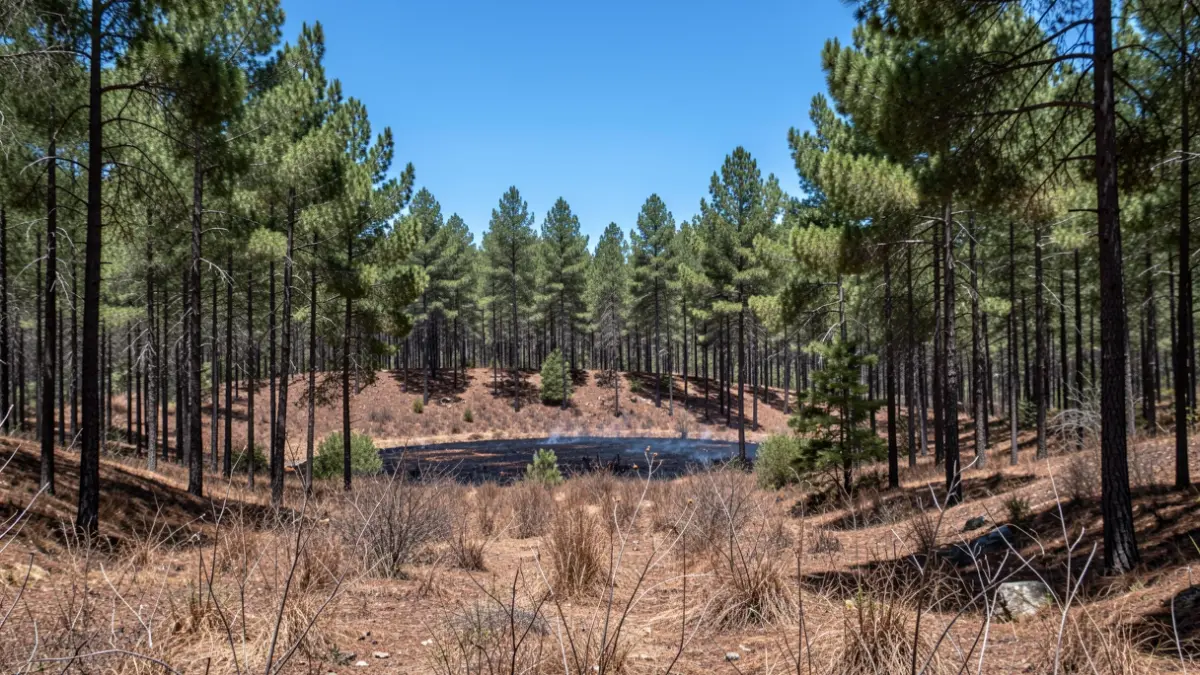
By 2026, over 3,500 hectares have already burned in Catalonia. With the arrival of summer and high temperatures, the risk of forest fires increases significantly. Between July 1st and 8th alone, 345 fires were recorded, and many mitigation strategies are not yet operational.
Jaume Minguell, Director General of Forests and Environmental Management, acknowledged the need to accelerate forest management actions. This includes creating cultivated fields, firebreaks around urban areas, clearing undergrowth, and using tree species less prone to fire spread. Since 2018, 23,000 cubic meters of pine wood have been removed, and the presence of cork oak forests, considered "more defensible" in case of fire, has increased. The goal is to stabilize so-called "megafires" or sixth-generation fires.
Tamara Garcia, Director General of Prevention, Fire Extinction, and Rescue, highlighted how prior forest management limited the fire in Sant Andreu de la Barca to 4.3 hectares. Clearing the forest reduced flame intensity, preventing the fire from reaching a 300-meter line of homes and the consequent need to divert resources. "What concerns us most is always the fire entering an urban area," Garcia emphasized, prioritizing public safety.
Catalonia's strategy until 2033 is based on three pillars: protection strips, priority protection perimeters, and containment axes. According to Minguell, recent experience with simultaneous fires confirms the plan's effectiveness.
Protection strips are firebreaks of at least 25 meters around urban areas. Their execution and maintenance are the responsibility of property owners and municipalities, supported by government grants of 15 million euros annually. It is projected that 3,000 hectares of these strips will be completed by 2027.
Priority protection perimeters cover 34 high-risk zones. The Government aims to consolidate them, with the goal of having them operational within two years, through infrastructure such as roads and water points for emergency services.
Containment axes, presented last May, aim to reduce the spread of large fires between forest massifs. 36.4% of the planned 2,300 hectares have been tendered, costing 3.7 million euros. Works on axes like Girona – Celrà and Martorell are temporarily halted due to high fire risk. The 14 planned axes are expected to be completed by 2033 at a total cost of 131.8 million euros.