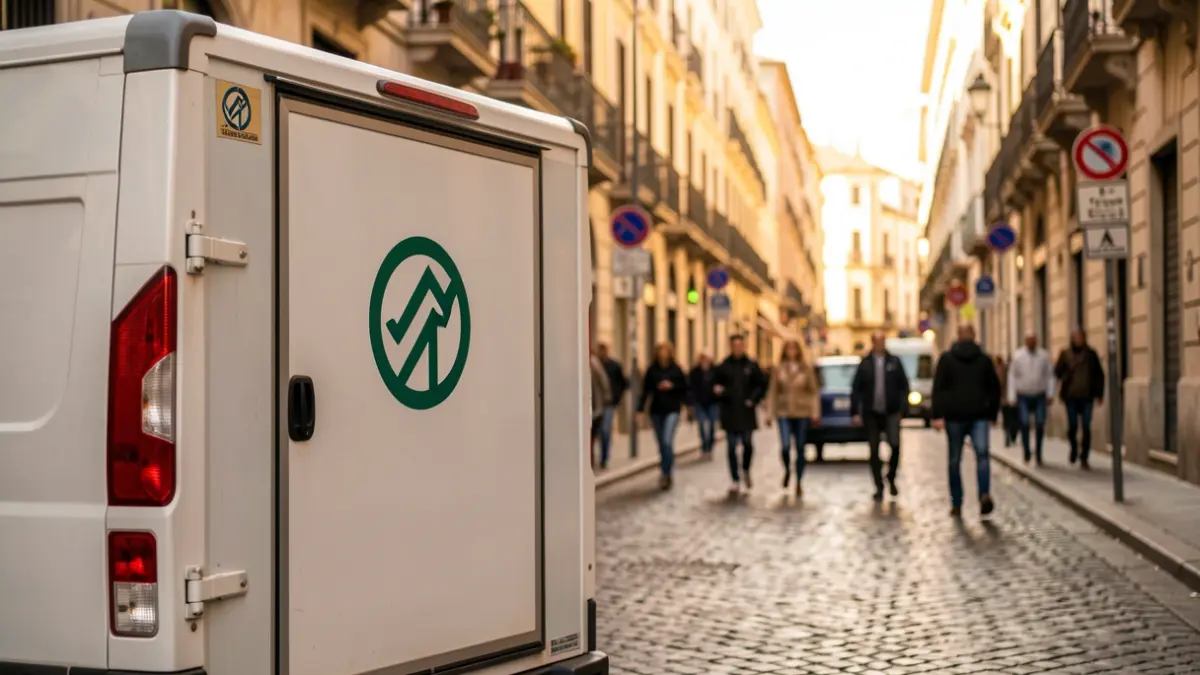
The hospitality distribution sector has begun using three exclusive loading and unloading spots as part of Horeca Hub Barcelona, an initiative testing a new way to organize deliveries and collections for bars, restaurants, cafes, and hotels.
This pilot project, driven by the Barcelona City Council, Barcelona Innova Lab Mobility, Fira de Barcelona, and Mobile World Capital Barcelona, utilizes an innovative solution developed by the Open University of Catalonia (UOC) in collaboration with ADISCAT. Eight distribution companies are participating: DDI – Distribución Directa Integral (Damm), Disbesa, Coseral BCN, Distribuciones Serrano, Dis Crusat, Discer, Qualianza, and Euroestrelle.
The project is part of the Barcelona Innova Lab Mobility (BILM) program, which aims to promote pilot tests for smart and sustainable urban mobility. The main objective is to transform the urban goods distribution (DUM) model, particularly in the HORECA sector, to reduce traffic and improve urban coexistence, contributing to the municipal goal of cutting professional mobility emissions by 50% by 2030.
The initiative encourages collaboration between companies and distributors to consolidate goods and minimize negative externalities, such as polluting emissions (31% PM10 and 34% NOX) and public space occupation. Goods distribution accounts for 17% of city mobility, with the HORECA sector representing 22.2% of deliveries.
The trial is initially taking place in three squares: one at the intersection of Pau Claris and Casp, and two in the Rambla del Raval. During designated hours, these spots will be exclusively for participating companies via a reservation system. Each location will accommodate seven coordinated vehicles to reduce search time for parking and avoid unnecessary routes. The trial will last a minimum of six months.
This action addresses the needs of a sector facing challenges due to a lack of nearby loading and unloading spots, particularly affecting the logistics of beverages, food, and other heavy goods, as well as reverse logistics for packaging.
“"Today we have taken a very important step as we move from diagnosis to a real test. Distribution companies are starting to use loading and unloading spots specifically designed for their operations and coordinated through technology."
The HORECA HUB model proposes that vehicles act as mobile micro-hubs, completing deliveries on foot or with light means from the reserved spots and collecting items for reverse logistics on the return journey.
A digital platform coordinates reservations, identifies vehicle arrivals, monitors usage times, and records deliveries and collections. The UOC contributes scientific and technological expertise through the groups Urbanization, Commerce and Sustainable Logistics (URBANLOG), Internet Computing C Systems Optimization (ICSO), and Wireless Networks Research Lab (WiNE), using tools for logistics optimization, IoT sensors, RFID technology, and tracking systems.
“"The loading and unloading regulation is designed for parcel delivery, and hospitality has a very different operation: heavy goods, kegs, boxes, frequent deliveries, and also packaging collection. That's why we want to understand how the distribution system we propose works on the street and, above all, to put data to it. With the sensors and the web application, we will be able to see how much time each spot is actually occupied, how deliveries are made on foot, and where the problems arise."
During the six-month trial, data will be collected to analyze delivery times, routes, vehicle numbers, spot utilization, and the experience of participants. HORECA HUB aims to generate a flexible and measurable methodology that can be adapted to other parts of the city and other municipalities.