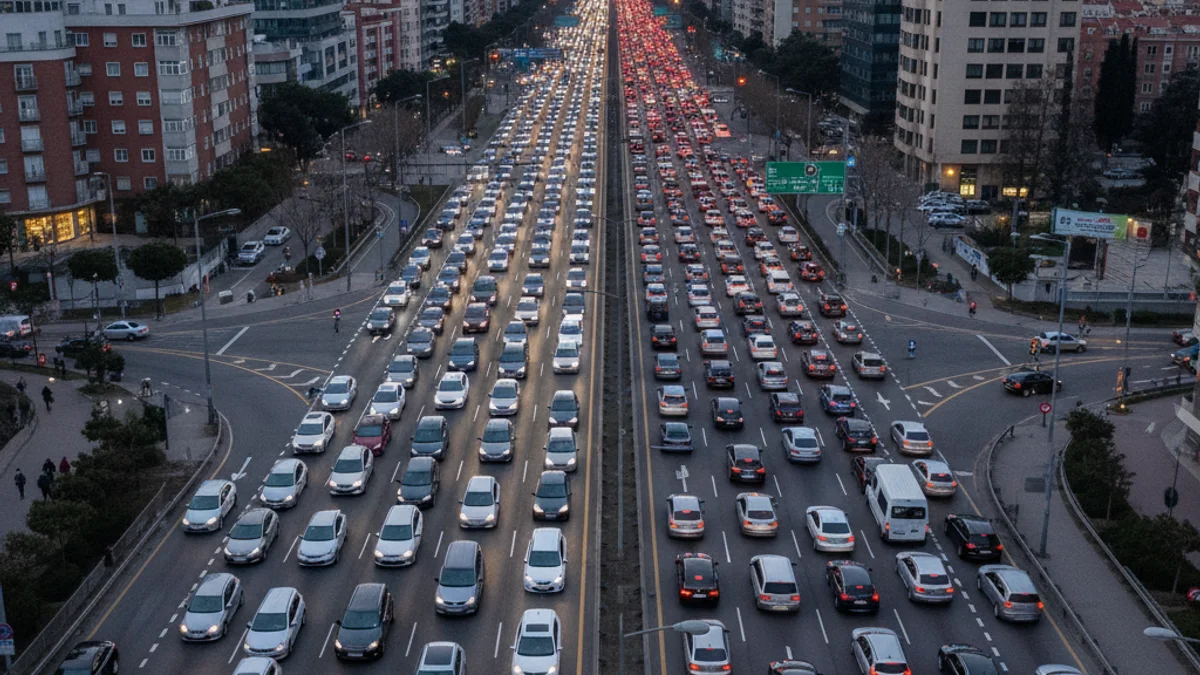
The decision by many commuters to avoid train delays and cancellations had an immediate impact on road traffic. The Ronda de Dalt (B-20) accumulated up to 11 kilometers of congestion, with 8 kilometers southbound at the Llobregat junction and 3 kilometers northbound at the Trinitat junction.
This situation was mirrored on the Ronda Litoral (B-10), where seven kilometers of traffic jams were recorded northbound, also at the Trinitat junction, and nine kilometers southbound, towards the Llobregat junction.
The Servei Català de Trànsit (SCT) also warned of significant retentions on other key routes. On the C-58, between Barcelona and Montcada i Reixac, four kilometers of congestion accumulated. There were also issues on the C-16, with two kilometers of slow traffic between Barcelona and Sant Cugat del Vallès.
The day of February 2 was marked by the failure to normalize the rail service. Only lines R11, R16, and R17 are operating normally, while 11 other lines (R1, RG1, R3, R4, RL4, R7, R8, R13, R14, R15, and RT1) require alternative road services.
Among the most notable disruptions, the R2 Sud line only offers two trains per hour per direction due to an infrastructure incident between Bellvitge and Sants. Furthermore, the R3 requires alternative road service between Fabra i Puig (Barcelona) and Puigcerdà due to scheduled track doubling works.